The pronunciation of ask (/ɑ:sk/ or /æsk/) as axe (/æks/) is a stigmatised feature of African-American Vernacular English [AAVE] which apparently is extremely salient to speakers of other dialects.
Note, for example, the following posting on Yahoo! Questions:
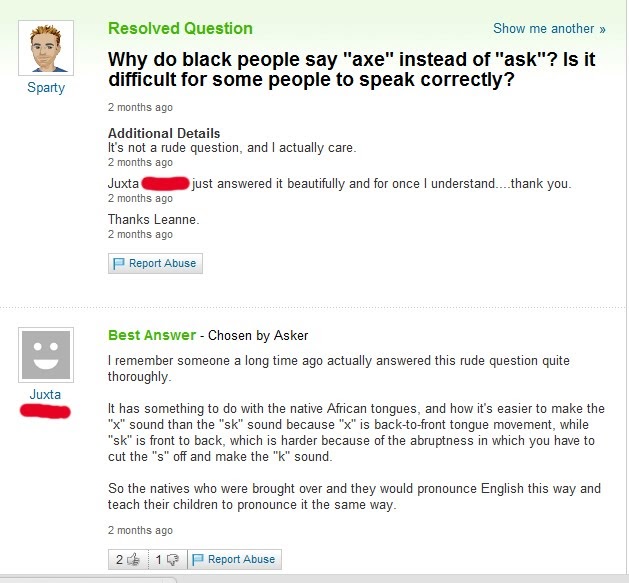
Technically, what axe involves is metathesis of the s. The above answer-and-reply on Yahoo is indicative of the popular opinion on people "axing" questions rather than "asking" them: saying "let me axe you a question" is seen as an error, and one specific to Black English speakers. But this metathesis, resulting in axe (/æks/) as a variant pronunciation of ask (/ɑ:sk/ or /æsk/), is not an innovation on the part of AAVE. Both metathesised and unmetathesised forms have co-existed throughout the recorded history of the English.
The author (or authors) of the Old English poem Beowulf, which narrates the adventures of the nobly-born hero of the same name, was an "axer" rather than an "asker". All three times the word appears in the poem, it appears in the metathesised form ācsian/āxian rather than āscian (l.423 āhsodon "they asked", l.433 geāhsod "learned by asking (past participle)", and l.1206 āhsode "he asked").
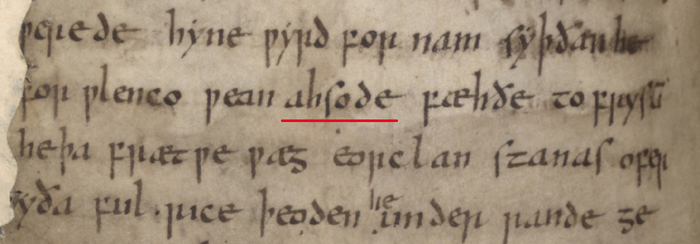
[The spelling hs rather than cs or ks (as in the Beowulfian ahsodon, ahsode etc.) is found as an occasional orthographic variant in West Saxon (both for Proto-Germanic *-χs-, which became -ks- in Old English and Old Frisian, as well as for -ks- of other origins, as in the case of ācsian spelled as āhsian). See further Campbell[1]:§416.]
During Beowulf's recounting in King Hrothgar's meadhall of his prior deeds and adventures--as proof of his fitness to fight Grendel--after he mentions the fact that he has destroyed the kin of ogres and amidst the ocean's waves slain sea-serpents (at night even), he states that he has avenged the Wederas (his clan) in these words (ll. 423-4a):
wræc Wedera nīð wēan āhsodon
forgrand gramum
These lines might be rendered in modern English as:
I avenged the Wederas,
crushed their foes (they axed for trouble!)
Beowulf is certainly not alone among Old English texts in using the metathesised form āxian rather than āscian; a search for the 1st & 3rd person past singular form of the verb using the Dictionary of Old English Web Corpus, reveals 164 hits for āxode, 61 hits for ācsode, and 41 hits for āhsode against only 5 hits for āscode. In other words, Anglo-Saxon writers favoured the "axe" form over the "ask" form at ratio of 266 to 5.
Historically, Old English āscian/āxian "to ask" derives from Proto-Germanic *aiskōn, which in turn comes from Proto-Indo-European *ais-sk (earlier *h2eis- plus the suffix *-sk); Sanskrit इच्छा [icchā] "wish" derives from the same PIE root. Thus, while the metathesised forms are an innovation in the history of English, they are an old innovation (as shown by Beowulf and other Old English texts), predating AAVE/Black English, and occurring in respectable--indeed, aristocratic--literature in preference to the non-metathesised forms. So there is no need to attribute the pronunciation axe (/æks/) to "African tongues", it is rather a long-standing variant in English.
I doubt Beowulf would have been impressed if Hunferth (rather than taunting him about his contest with Breca) had informed him that he should have said "āscodon" rather than "āhsodon"...
[Additional note (23.10.09): The "axe"-variant is also attested in Middle English:
Axe not why : for tho' thou axe meI wol not tellen goddes privetee.(Chaucer, Miller's Tale, v3557)
And "axe" is also found in various English dialects at least into the 19th-c.; on which see Cooper[2]:28-9.]
[Incidentally, there is a 2008 movie Beowulf: Prince of the Geats (which I have not seen yet), in which Beowulf's father is an African explorer whose travels led him to Geatland. On some reactions to the film, see the article Beowulf: Prince of the Geats, Nazis, and Odinists".]
References:
[1]Campbell, Alistair. 1959. Old English grammar. Oxford: Clarendon.
[2]Cooper, William Durrant. 1853. A glossary of the provincialisms in use in the County of Sussex. London: John Russell Smith, 2nd edn.