Showing posts with label historical linguistics. Show all posts

Monday, 18 June 2012

"Oh, no, maadarcho-": On subtitling vulgarities in Hindi films

John McWhorter, in his recent New Republic article, "Gosh, Golly, Gee: Mitt Romney's verbal stylings", discusses what he appears to view as Romney's over-sanitised style of public speaking as a marker of inauthenticity. Lucy Ferriss, in her post "Jeepers!" on the Lingua Franca site, is somewhat sceptical of this argument.

However, what struck me in Ferriss's post was the following paragraph, because it touches on something I was pondering a couple of days ago.
It is certainly true, as McWhorter observes, that public discourse has grown more casual and that examples of “taking the name of the Lord in vain” are not so proscribed as they once were. I only became aware of my own habitual use, not only of various expletives involving Judeo-Christian names for the deity, but of designated euphemisms, when I was in Pakistan recently. I would start to say, “Jesus, it’s hot,” and realize that my hosts’ theological frame of reference was somewhat different. Soon I began censoring not only “God” and “Christ,” but also “jeez,” “criminy,” “omigod,” and “lordy.” It was surprisingly easy to do, and as my speech changed, I also noticed no swearing (at least in English) on the part of my interlocutors, who did use other American slang freely.
 An oddly persistent feature of Hindi-language film English subtitling is the bowdlerisation of cursing. A particularly amusing instance of this occurs in the film Murder 2, a somewhat gruesome thriller. The main character, a hard-boiled ex-cop, is verbally abusing another character, and calls him मादरचोद (mādarchod).* Now mādarchod means "one who has sexual relations with his mother" and thus has a readily available and obvious English gloss. However, in the English subtitles mādarchod is rendered as "scoundrel". The disparity between the original and the translation afforded me a good chuckle (my wife simply ignores the subtitles, so wondered why I started laughing).

What is even more amusing is that this bowdlerised subtitling extends to subtitling English as well. So, in the same film, when the hero disgustedly says "Fuck." in sotto voce, the subtitles tell us that he said "Oh, no!".

I wonder if there is a certain subset of South Asians (who can speak English, and reside somewhere in South Asia, as opposed to abroad) who are uncomfortable with cursing in English (even if they do so in other languages) - this subset would seem to include everyone who provides English subtitles for Hindi films.

Postscript: "Taking the name of the lord in vain" doesn't translate well very into a Hindu setting. Hindi speakers will exclaim हे भगवान! (he bhagwān) "Oh, lord!" in times of crisis (or mock-crisis), and likewise will say "Oh, lord!" or "Oh, god!" in English in the same fashion. But these are all what I would call vocative uses, supplications to divine powers for assistance (and I would think "lordy" would fit into this category too). I can't think of Hindi language curses which parallel zounds (< "by god's wounds"). Hindi swearing usually involves some sort of reference to sex or sexual organs, usually involving someone else's mother or sister --- बहिनचोद (bahinchod) "one who has sexual relations with his sister" being in fact a bit more typical than मादरचोद (mādarchod).

 * मादरचोद (mādarchod) is interesting from the standpoint that mādar is a borrowing from Persian but is infrequent outside of this compound. That may well not be accidental --- its use in other contexts may be "blocked" by association with mādarchod.

Sunday, 3 July 2011

What speechitatest you? On engineered language change amongst high schoolers


The latest Saturday Morning Breakfast Cereal, on high school language change:


Note:
The type of language change the students are shown undergoing would require more than a source of new lexical items, I would think.

We find morphological change: Wouldsest for 2nd person singular present of "would".

And syntactic change: What speechitated Harvard? for "What did Harvard say?" (note the necessity of do-periphrasis in modern English).

How could a thesaurus (of fake synonyms) drive these sorts of changes? [Of course, under Minimalism, parametric variation, including differences in word order, is theorised to be a reflex of formal features which are borne by lexical items. So perhaps if the thesaurus had some way of encoding abstract syntactic features in such a way that they would be picked up along with the phonological and semantic aspects of the lexical item....]

Wednesday, 8 September 2010

English "like" can, like, function like Sanskrit "इति"

In a recent blog post, "How Old is Parasite 'Like'?", Oxford Etymologist Anatoly Liberman explores the history of (modern) English like when used as a type of filler/discourse-marker. However, modern English like has another function, which I think is often conflated with filler like (presumably because it commonly occurs in the speech of people who also use filler like): namely, as a sort of quotative marker (also noted by commenters Mike Gibson and Charles Wells).
She was like OMG! And then I was like wow!
The above sentences might be "translated" as:
She said, "Oh my god!" And then I said, "Wow!"
Or (since there seems to be some ambiguity):
She said, "Oh my god!" And then I thought, "Wow!"
This use as a sort of quotation mark is a separate function from its pragmatic discourse-marking use (which Liberman focusses on) in examples like:
You wanna, like, go see a movie?
Which might be uttered by a teenage boy asking a girl out on a date , where like can either act as a "hedge", foreseeing the possibility of rejection ("....it's ok if you don't want to"), or to allow for the possibility of other activities ("...or get some ice cream").

Both uses of like are stigmatised; again, the stigmatisation of "quotative" like is probably via guilt-by-association with the discourse-marking/filler like. I'll admit that, like Liberman, I find both uses rather aesthetically displeasing (which doesn't mean that I never use them---they are, as Liberman suggests, somewhat viral). But the "quotative" like is interesting. Though Liberman remarks that:
Particularly disconcerting is the fact that the analogs of like swamped other languages at roughly the same time or a few decades later. Germans have begun to say quasi in every sentence. Swedes say liksom, and Russians say kak by; both mean “as though.” In this function quasi, liksom, and kak by are recent. The influence of American like is out of the question, especially in Russian. So why, and why now? Delving into the depths of Indo-European and Proto-Germanic requires courage and perspicuity. But here we are facing a phenomenon of no great antiquity and are as puzzled as though we were trying to decipher a cuneiform inscription.
Interestingly, however, the "quotative" function of English like has a couple of parallels in Sanskrit. One is these---the one most closely resembling English "quotative" like, at least in its frequency---is the Sanskrit particle iti (इति).

Both Sanskrit iti and English like can occur in the following contexts:
A. When quoting words actually utttered, alongside a verb of speaking:
(Skt-1) kathitam avalokitayā "madanodyānam gato mādhava" iti
"Avalokita had told me that Madhava was gone to the grove of Kama." [Mālatīmādhava I, p. 11; cited from Speijer[1]:§493a]

(Eng-1) "She said like 'I want to go too'."

B. Expressing the contents of one's thought:
(Skt-2) manyate pāpakam kṛtvā "na kaścid vetti mām" iti
"After committing some sins, one thinks 'nobody knows me'." [Mahabharata 1.74.29; cited from Speijer[1]:§493b]

(Eng-2) “And I thought like 'wow, this is for me'.” [OED, 2nd Supplement[2]; 1970, no earlier citations]

C. More general setting forth of motives, emotions, judgements etc.:
(Skt-3) vyāghro mānuṣam khādati iti lokāpavādaḥ
"'The tiger eats the man' is slanderous gossip." [Hitopadesha 10; cited from Speijer[1]:§493c]

(Eng-3) "I was like 'wow'!"
There are obvious differences between English quotative like and Sanskrit iti, including the fact that English quotative like precedes the "quotation", while Sanskrit iti follows it (in conformity with the general left-branching nature of Sanskrit syntax).

Further, Sanskrit iti doesn't have any of the other functions or meanings associated with English like. English like derives ultimately from Proto-Germanic *lîko- "body, form, appearance", while Sanskrit iti is built from the pronominal stem i-. In fact, iti still has pronominal uses, even in Classical Sanskrit, as in the following example.
(Skt-4) tebhyas pratijnāya nalaḥ kariṣya iti
"Nala promised them he would do thus." [Nala 3,1; cited from Speijer[1]:§492]
Amusingly, I find that (pretending that a parallel development has taken place in English) replacing "quotative" like with thus actually seems grammatical to me---though wholly unidiomatic, e.g.:
(Eng-4) "I was thus: 'Wow!'"
(Somehow I imagine that if thus had been recruited as a quotative in English rather than like, the use of a quotative marker wouldn't be so stigmatised, since there would be no association with filler like and, moreover, thus is largely used in formal registers of English.)

However, there is another element in Sanskrit which---though not as frequently used in this function as iti---actually is more similar to English quotative like in its syntax and semantics: yathā. Yathā is, properly speaking, a relative pronoun and is often part of relative-correlative constructions of the form yathā X...tathā Y "As X...., so Y". However, it can occur without correlative tathā, and in fact can have the meaning "like", as in the following example:
(Skt-5) mansyante mām yathā npam
"They will consider me like a king." [Mahabharata 4.2.5; cited from Speijer[1]:§470a]
Yathā can also function as a sort of quotative, but---unlike iti and like like---it precedes rather than follows the quoted discourse:
(Skt-6) viditam eva yathā "vayam malayaketau kimcitkālāntaram uṣitāḥ".
"It is certainly known (to you) that I stayed for some time with Malayaketu." [Mudrarakshasa VII; cited from Speijer[1]:§494]
(Or, maybe: "You certainly know, like, 'I stayed for some time with Malayaketu'.")
(Yathā and iti (since they occupy different syntactic positions) can also co-occur.)

So there is at least one antique parallel for the development of modern English like as a quotative marker.

Returning to the more commonly used iti, the following Sanskrit example---occurring when one of the heroes of the Mahabharata has performed an act of generosity so great that even the gods are impressed---I think is a great parallel for examples like "I was like, 'Wow!'":

(Skt-7) tato 'ntarikṣe vāg āsīt "sādhu sādhv" iti
"Then a voice in the sky was like 'Wow! Wow!'" [Mahabharata 14.91.15]
This line might be more usually translated as "then a voice in the sky said 'Bravo! Bravo!'", but there is actually no verb of speaking: āsīt means "was".

References:
[1] Speijer, J.S. 1886.
Sanskrit syntax. Leiden: E.J. Brill. [reprinted, Delhi: Motilal Banarsidass, 1973.]
[2] The Oxford English Dictionary, September 2009 rev. ed.


Tuesday, 3 August 2010

Computational approaches to understanding language evolution [video]

In her recent ILLS talk, Tandy Warnow discusses computational approaches for inferring language evolution and linguistic relationships:

Computational methods for inferring evolutionary histories of languages

A page with links to various publications associated with this project (and the datasets used) is available here: http://www.cs.rice.edu/~nakhleh/CPHL/.

One of the interesting points of this study is the relationship of Germanic with respect to the other branches of Indo-European. Germanic, at least when the morphological data is given more weight, is not particularly closely related to Italic or Celtic, though it shares a number of lexical similarities with these groups. This is suggestive of a later migration of Germanic-speaking peoples into an area where they came into contact with Italo-Celtic speakers. In any case, it's an interesting approach to historical data.


For more ILLS2 videos, see this link: http://ills.linguistics.illinois.edu/current/showcase.html.

Monday, 7 December 2009

Hot for Words: On titillating etymologies and pop philology (with some remarks on Beowulf movies and sex thrown in for good measure)

I came across an article by Marc Bousquet, "Teaching for Lust" on Brainstorm, the blog of The Chronicle of Higher Education, discussing Marina Orlova (Марина Орлова), a self-employed philologist who produces a YouTube series "Hot for Words".

Apparently Marina started her YouTube channel back in 2007, but I'd never heard of her until this week. I haven't seen her discussed in any of the usual places (Language Log, languagehat, etc. [update: "Hot for Words" was actually discussed a couple of times at the blog bradshaw of the future{sweostorword}; I overlooked these posts obviously.]). I'm usually on the lookout for video clips having to do with language but somehow I missed this series.

Here's the first video she posted (the more recent videos are much more polished):


And a blurb from her website:
Marina Orlova, known to millions of fans around the world as a sexy master of language, HotForWords, is a 28 year old Internet “sensation”. Hailing from Moscow, Marina has two degrees in philology which is the study of linguistics and origins of words. Back in Russia Marina taught English and World Literature to high-schoolers. She came to the United States six years ago to improve her English skills and prepare for her Ph.D., but she ended up staying in the U.S. simply because of the warmer weather. Two and a half years ago, Marina burst onto the YouTube scene. Her initial goal was to reach more people with her language knowledge...In each video she takes word requests from YouTube users and discusses their meanings and origins. Something that might, at first, seem boring, but when a buxom blonde with a Russian accent teaches you anything, it can be quite educational, thus proving, as her tag-line states, that “Intelligence is Sexy.”
Obviously part of her popularity is simply because sex(iness) sells. But is this a bad thing?

I had some concerns about whether her philology would be sound, especially as she's apparently a recurrent guest on Fox News' The O'Reilly Factor---and I don't associate Fox News with "truthiness".

The few "Hot for Words" videos I watched, however, seemed largely accurate. I mean, they weren't deep, and I'm guessing Orlova takes a lot of etymologies straight from the OED, but I didn't notice any serious misinformation. Etymologies seem to be her main trade, though she does have a video which touches on sound change, dealing with the pronunciation of kn-initial words (where knife is illustrated by a khukuri!), and a bit on neologism.

Turning back to the "Teaching for Lust" article, Bousquet's comments on Orlova are rather perplexing:
Youtube phenom “Hotforwords” raises the ante on the “teaching for love” canard. In the process, she schools us on how teaching really can realize the administration’s dream in the form of the ultimate “quality” process.
The 27-year-old Russian philologist is a former Ph.D. aspirant and high-school literature teacher with nearly 30 million views of her videos explaining various linguistic puzzles, such as — in the featured clip — how “dope” can mean both stupid and excellent.
One might ask the same about the term “quality,” which for administrators means, well, this.
Seriously, there’s no disputing her metrics. It’s teaching as “vaudeville,” as The New York Times’s Virginia Heffernan points out, but her curriculum is customer-defined and market-oriented. She is a self-funding responsibility center. She gets great student evaluations. Her teaching methods are susceptible to straightforward assessment instruments. There isn’t a “quality” complaint to make about her.
Oh yeah, and it’s totally exploitative, which makes a nice fit with all the outsourcing and permatemping.
Marina’s teaching for love (of fame) is not entirely divorced from the phenomenon that Michelle Masse analyzes as the feminization of the humanities — the reduction of whole fields of faculty work to second-class status by way of the gender economy: part of the cheapening and degradation of the work is the tacit recognition of it as women’s work, as a service, compensated by something other than wages. In connection with her forthcoming SUNY collection Ten Million Served with Katie Hogan, she observes how the call to “service” is one of the most compelling vectors of exploitation in academic life.
Masse points out that “secretary” and “nurse” used to name well-remunerated, well-respected positions for men. Kinda like “professor of language.” Now that it’s women’s work, it’s best done as a kind of lightly-paid volunteerism — for love, or, as in Marina’s, case, something closely allied to it.
Now, Masse's remarks (see link above) seem to be on target, but I'm not sure how this relates to sexed-up YouTube mini-philology, as Bousquet suggests. [Update: Orlova actually replied to Bousquet's commentary: see here.]

Orlova doesn't seem to be teaching just for "love": she's a revenue-sharing YouTube partner, she's signed an endorsement deal with "coComment", and she's published a book with HarperCollins. If she started out teaching for "love (of fame)" as Bousquet argues, I assume it was because she figured she could parlay that fame into money.

But how does this affect academics? Bousquet seems to imply that university administrations are going to outsource philology/historical linguistics to "Hot for Words". Now, admittedly university administrators often make stupid decisions, and many linguistics departments aren't refilling their historical linguistics posts---but I don't think it's because they believe they can outsource philology to Orlova.

I think, rather, such things can act to spark people's interest in a topic, and thus have a positive effect for academics: if even a small percentage of young people who watch Orlova's series become interested in etymology, some of them may decide to enrol in an historical linguistics course that they wouldn't have otherwise. Higher enrolment in historical linguistics courses = less possibility of departments deciding not to refill their historical linguistics positions.

I won't deny the vaudeville-angle of "Hot for Words", but that's why it works of course. I play YouTube clips for my students, like "A Bit of Fry and Laurie (on Language)" during my discussion of generative vs. formulaic language; and this clip from an old Fawlty Towers episode when discussing language contact. The clips don't substitute for course material, but rather supplement it by serving to maintain students' attention and get them interested in the topic we're discussing.

It seems to me that "Hot for Words" does something similar: the scantily-clad buxom blonde draws the audience in, but at least they get taught a bit of etymology. For example, in one video, Orlova answers a viewer's question about whether titillating has anything to do with tits (tits can be titillating is the logic behind the question). Now, obviously in part the viewer's question was motivated by a desire to hear a busty Russian woman talk about tits, but Orlova does answer the question, explaining that titillate derives from Latin titillāre "to tickle", and (briefly) discusses the semantic changes leading to the predominant modern sense. (Her discussion of tits was, I think, a little off, as she derived the word ultimately from Old French tete, tette, taite, but the development appears to be more complicated than that, since Old English has tit(t) and the modern form seems likely to derive from some mixture of both of the Old English and the Old French.)

A parallel that comes to mind is the effect on Anglo-Saxon studies of Beowulf movies--which have also tended to use sex to draw viewers in:
While none of the recent Beowulf-based films are particularly faithful to the original poem, they increase awareness of Beowulf and thus have the potential to raise enrolment in Old English courses.

"Hot for Words" would seem to have a similar potential effect: to arouse interest in philology, and thus perhaps get a few more bodies into historical linguistics classrooms.

Wednesday, 14 October 2009

Vyākarana - व्याकरण (+Pānini and writing)

India might be considered the original homeland of generative linguistics on at least two counts.

Firstly, it was in India (and on the basis of the structure and lexicon of Sanskrit) where the idea of an Indo-European language family was developed, a concept which was to form the basis for the study of historical and comparative linguistics from which the modern linguistic traditions ultimately derive. Generative linguistics, as pioneered by Noam Chomsky, grew out of the earlier structuralist approach to linguistics as developed in America by Leonard Bloomfield. Bloomfield himself was greatly influenced by Ferdinand de Saussure's Course in General Linguistics (1916), which suggests that language should be understood as a system of interconnected parts. Saussure's structuralism, though it focusses on the synchronic study of language as a static system, has its root in the earlier study of historical (diachronic) linguistics. In the 19th century, linguistics meant historical linguistics, and Saussure himself had previously worked on Indo-European from a diachronic perspective (famously anticipating the later discovery of Hittite 'laryngeals' in his proposal of Proto-Indo-European 'sonant coefficients').

The starting point for the modern study of diachronic linguistics can reasonably be argued to be 1786, when Sir William Jones delivered his paper on the history and culture of the Hindus before the Asiatick Society in Calcutta (later published in 1788 as "The Third Anniversary Discourse, On the Hindus"). In this paper Jones stated that:

The Sanscrit language, whatever be its antiquity, is of a wonderful structure; more perfect than the Greek, more copious than the Latin, and more exquisitely refined than either, yet bearing to both of them a stronger affinity, both in the roots of verbs and the forms of grammar, than could possibly have been produced by accident; so strong indeed, that no philologer could examine them all three, without believing them to have sprung from some common source, which, perhaps, no longer exists; there is a similar reason, though not quite so forcible, for supposing that both the Gothick and the Celtick, though blended with a very different idiom, had the same origin with the Sanscrit; and the old Persian might be added to the same family, if this were the place for discussing any question concerning the antiquities of Persia.

It was with Jones' discovery of the genetic relation of Sanskrit (the classical language of India) to Latin and Greek (as well as Celtic and Germanic) that the study of historical linguistics came into existence.

Secondly, there is an indigenous Indian tradition of linguistic analysis, dating back to at least the 4th century BC, which has helped to shape modern generative linguistics: Chomsky's development of a theory of language as involving formal generative rules clearly owes a large debt to Pāṇini's Aṣṭādhyāyī (6th-4th c. BC?), a grammar of Sanskrit morphology stated in terms of transformation rules.

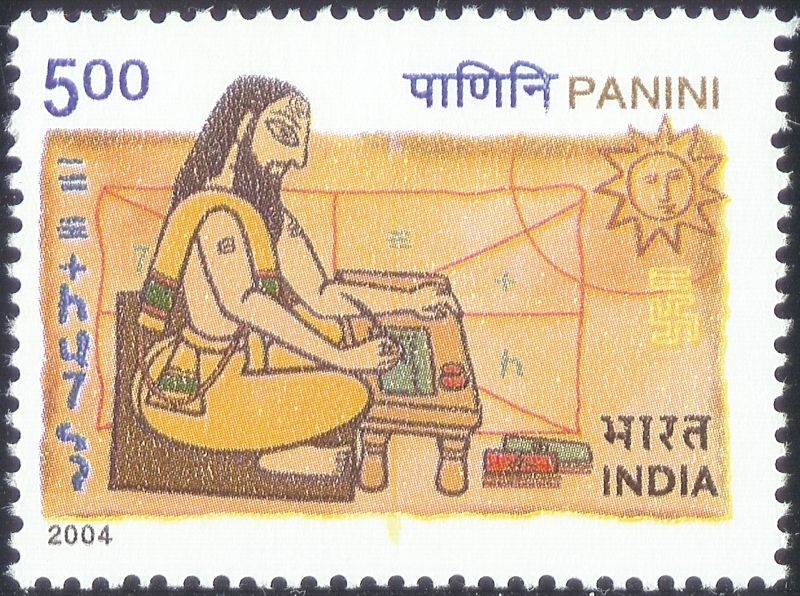
When I was in India (2003-5), one day when I went to post a letter I was pleasantly surprised to find that the Indian Department of Posts had issued a Pāṇini stamp (see the press release here).


Interestingly, Pāṇini is depicted on this stamp writing his grammar. Since one of the characteristics of Pāṇini's grammar is its conciseness (3,959 sutras), it would seem more likely that it was orally-composed and transmitted. If it had been a written text, why would Pāṇini have favoured brevity over clarity? (No traces of true writing systems have been found in India predating the 3rd c. BC Brāhmī Ashokan inscriptions.)

One of the characteristics of Indian writing systems like devanāgarī is that they are--unlike for instance Greek and Roman alphabets--arranged according to phonetic principles: the vowels come first, then the velar stops, palatal stops, retroflex stops, labial stops etc. This seems to be a result of having invented linguistics before writing.

The Sanskrit grammatical tradition is known as vyākaraṇa, and is considered one of the six vedāṅgas (auxiliary disciplines for understanding the Vedas [the oldest sacred texts of India, consisting largely of ritualistic formulae and hymns]). Vyākaraṇa (= vi + ā + kṛ 'to do') has a general (and compositional) meaning "separation, discrimination, distinction", but also possesses a narrower sense "explanation, description", as well as the specific sense "grammar, grammatical analysis" (as in the title of this blog).