Showing posts with label etymology. Show all posts

Wednesday, 18 May 2011

The Rapture, now with more Harpies

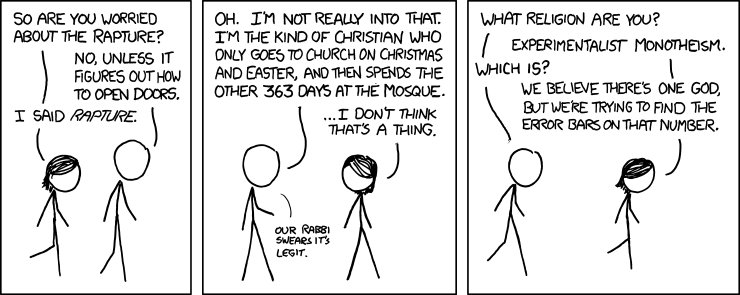
The latest xkcd:
(Mouse-over text: But to us there is but one God, plus or minus one. --1 Corinthians 8:6±2.)

The first panel is really the funniest bit: a pun on raptor (referencing the Jurassic Park movie). But in fact, rapture and raptor are not only phonologically similar, they're also etymologically related: both deriving from Latin rapt-, the past participial stem of rapere "to seize, to snatch, to carry off".

Also from Latin rapere are subreptitious "snatching under", rapacious "(greedily) snatching (with the intent to eat)", and rape (originally "carrying off", then "carrying off, esp. with the intent of sexually despoiling", later coming to refer specifically to "forced sexual intercourse").

Raptor in classical Latin meant "robber, thief", which is its meaning also in early English, later on in English it can also mean "rapist". From the 18th century, it was applied to "birds of prey", whence its later extension to refer to a particular "dromaeosaurid dinosaur", the Velociraptor "swift seizer".

Rapture, on the other hand, is not found in classical Latin, though it does appear in mediaeval Latin. The earliest citation the OED provides is from an 8th-century British text, in the form raptura, referring to "poaching". Its use in English, however, originally is confined to the sense (attested from the 16th century) of "extreme joy, intense delight". Though it was also used in the 17th and 18th centuries to refer to the "carrying off" or "rape" of women.

And not until the 18th century does rapture acquire its Millenarial sense (associated with ideas originally advanced by the Puritans Increase and Cotton Mather in Massachusetts). The word rapture in this Millenarial philosophy apparently picks up on the Latin word rapiemur (from rapere, see above) used in 1 Thessalonians 4:17 to refer to the faithful being "carried up" into the air (to meet Christ) in the Latin Vulgate:
deinde nos qui vivimus qui relinquimur simul rapiemur cum illis in nubibus obviam Domino in aera et sic semper cum Domino erimus
The Latin Vulgate of course is a translation of the Koine Greek text, and in this passage Latin rapiemur glosses the Greek ἁρπαγησόμεθα "we shall be caught up":
ἔπειτα ἡμεῖς οἱ ζῶντες οἱ περιλειπόμενοι ἅμα σὺν αὐτοῖς ἁρπαγησόμεθα ἐν νεφέλαις εἰς ἀπάντησιν τοῦ κυρίου εἰς ἀέρα: καὶ οὕτως πάντοτε σὺν κυρίῳ ἐσόμεθα.
Interestingly, Greek ἁρπάζω "catch up, snatch up"---of which ἁρπαγησόμεθα is the first person plural future passive indicative form---originates from the same Proto-Indo-European root as the Latin rapere which St Jerome uses to gloss it: PIE *h1rep- "to snatch" (also the source of English reap).


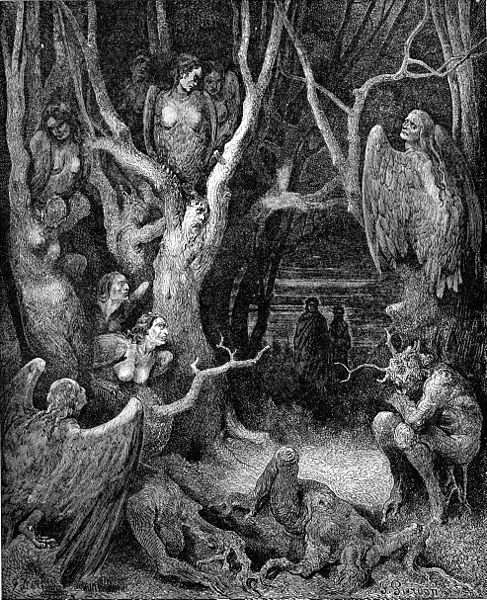
From the same Greek root as ἁρπάζω "catch up" is the word which comes into English as harpy: Greek ἅρπυια "the snatcher". So, with that, I leave you with some Harpies to flavour your Rapturous visions, courtesy of Gustave Doré:

[Edit (20 May 2011): Now see Mark Liberman's "No Word for Rapture" on Language Log for further etymological discussion of rapture.]

Wednesday, 23 March 2011

Linguistics Behind the Wicket (LBW) #1: Shahid Afridi and Free Love Friday

In belated celebration of the breaking of Australia's 34-match unbeaten run in World Cup matches by Pakistan, I offer the first in what I plan to be a recurring series of cricket-related linguistic investigations. I'm dubbing this series LBW ("Linguistics Behind (the) Wicket").

Shahid Afridi after the 2011 World Cup Pakistani victory over Australia
Shahid Afridi during the Pakistani World Cup 2011 match with Australia

This first investigation is a study in onomastics, taking as its subject the name of the skipper of the Pakistan team: Shahid Afridi (Urdu: شاہد آفریدی). To find out the connection between Afridi and free, "love", and Friday, read on!

[A brief word about the sources of Hindi/Urdu words: alongside of the native Indo-Aryan vocabulary (inherited, ultimately, from a vernacular cousin of Sanskrit), both the Hindi and Urdu varieties of Hindi/Urdu employ a large number of Persian and Arabic words (as a result of the Mughal invasion of India).]

Shahid (Hindi: शहीद; Urdu: شاہد) is an Hindi/Urdu word of Perso-Arabic origins, meaning "martyr" (religious or political). It derives ultimately from an Arabic root شہد, which Platts[1] glosses as meaning "to give testimony". Not being a semiticist, I cannot offer any further interesting discussion.

It is rather the name Afridi (Hindi: आफ़्रीदी; Urdu: آفریدی) which is of more interest for me. Jokingly, I have sometimes referred to Afridi as "Afriti", since his aggressive cricketing (Afridi holds the record (37 deliveries) for fastest century in one-day cricket) and mercurial temperament is suggestive of an Arabian Afreet (an angry sort of djinn): Arabic ʻIfrīt عفريت, pl. ʻAfārīt عفاريت. [The origin of this word is rather opaque to me: Platts[1] derives it from an Arabic root عفر meaning "to roll in the dust"; the Wikipedia article suggests that it comes from عفرت (`afrt) meaning "the evil"; the translation of the Qur'anic passage, Sura An-Naml (27:39-40) seems gloss it as "strong one". Maybe semiticists could enlighten me here?]

However, Āfrīdī, in fact, has no connection with Arabic "Afreet". Rather, it is a word of Iranian origin, which, being the name of a certain Pathan tribe, is thus presumably indicative of Shahid Afridi's ancestral origins.
afridi soldiers
Some afridis in the Khyber Rifles

In terms of its etymology, the word āfrīdī can be derived from the Persian word آفريده āfrīda, which means "creature" (noun) or "created" (adjective). (The āfrīdīs are thus perhaps "the created people".)

Āfrīda itself can be derived as the past/perfect participial form of the Avestan root frī- "love" combined with the prefix ā- (theoretically contributing a sense of "near, towards", but sometimes resulting in idiosyncratic meanings). Avestan āfrīda would corresponds to Sanskrit āprīta, both meaning "gladdened, joyous" etc.

The semantic change from Avestan "gladdened, joyous" to Persian "created" is intriguing. The earlier meaning of "joy" still seems to be present in Persian (and Hindi/Urdu) āfrīn/āfirīn, which can be used to mean "bravo! well done!" (though it too can have the "create" sense, at least in the compound jahān-āfirīn "creator of the world").

The root underlying both Sanskrit āprīta and Avestan āfrīda is Proto-Indo-Iranian *prī-, which itself can be traced back to the Proto-Indo-European root *prī- whose most basic sense is "to love".

The PIE root *prī- (see Watkins[2]) is also the source of English free (from Old English frēo, derived from the verb frēon "to love, to set free"), friend (from Old English frēond "friend, lover"), and Friday (from Old English Frīgedæge "Frigg's day", where Frigg, the name of the Scandinavian goddess of love, Odin's wife, derives from Proto-Germanic *frijjō "beloved, wife"); as well as Old English frioðu "peace", which sadly has no direct reflexes in modern English.

In fact, PIE *prī- underlies not only the Persian tribal name Afridi, but also a variety of Germanic-derived names (see Watkins[2]), including:
  1. Siegfried, from Old High German Sigi-frith "victorious peace"
  2. Godfrey, from Old High German Goda-frid "peace of god"
  3. Frederick, from French Frédéric, itself a borrowing of Old High German Fridu-rīh "peaceful ruler"
  4. Geoffrey, from Old French Geoffroi from mediaeval Latin Gaufridus, itself a borrowing from Germanic *Gawja-frithu- "(having a) peaceful region"
Thus perhaps Geoffrey Boycott can mention his "prī-" connection with Shahid Afridi if he ever needs some filler material when commentating a Pakistan match...

So, this concludes the first LBW. I'm open to suggestions for other cricketers or cricket terminology to etymologise for future episodes.

Bibliography:
[1]Platts, John T. 1884. A dictionary of Urdū, classical Hindī, and English. London: W. H. Allen & Co., 1884. (Reprinted, New Delhi: Munshiram Manoharlal, 2000.) [online]
[2]Watkins, Calvert. 2000. The American Heritage dictionary of Indo-European roots. Boston: Houghton Mifflin, 2nd edn.
[3]McGregor, R.S. 1993. The Oxford Hindi-English dictionary. Oxford: Oxford University Press. (Indian edition: New Delhi: Oxford University Press, 1994.)

Thursday, 10 February 2011

Minecræft. (Minakraft?)

The biggest indie game of 2010: Minecraft. Since it shares half a compound noun with the title of this blog, that seems as good an excuse as any to look at the "etymology" of Minecraft.

First, in case you're unfamiliar with Minecraft, here's a video:


In terms of Minecraft's design inspiration, its creator, Markus "Notch" Persson, attributes its origins to Infiniminer, Dungeon Keeper, Left 4 Dead, and Dwarf Fortress (the last has been described as a mixture of Nethack, Oregon Trail, The Sims, and Lemmings).

Etymology 1: "the art of mining"
If Minecraft were truly parallel to stæfcræft, then it would be what is referred to in Sanskrit grammar as a tatpuruṣa (तत्पुरुष) compound , that is, a compound of the form YX, where X is the head noun and Y relates to X as if it were some non-nominative case form, e.g. a genitive, dative, etc. For example, the tatpuruṣa compound mousehunter is a hunter (=X) of mice (=Y). If this were the case then Minecraft would mean something like "the craft of mining", i.e. "the art of mining",---which in fact is an analysis which makes eminent sense, given that mining is a major component of the game.


Etymology 2: "mining and crafting"
Another possibility, however, is that Minecraft is what is referred to in Sanskrit grammar as a dvandva (Sanskrit द्वन्द्व dvandva 'pair') compound, that is a compound of the form YX, where X and Y could be otherwise expressed as X and Y. For example, the dvandva compound producer-director (duo) is someone who is a producer and a director a pair of people, one of whom is a producer, and one a director [examples: (1), (2), (3), (4)]. This would also seem a plausible analysis, given that aside from mining, crafting items is the other major component of the game (well, alongside trying not to get eaten by zombies or blown up by creepers).


An excursus on mine and craft
A third possibility, which presents itself in view of the fact that the game's creator, Persson, is Swedish, is that it is indeed a tatpuruṣa compound, but a Swedish compound rather than an English one. To explore this possibility, it's worthwhile to delve deeper into the etymologies of mine and craft.

Mine, in English, derives from an Anglo-Norman word mine, which was more or less a form of Old French (the word mine is found c1220 in Old French with sense 'underground cavity or excavation where metals and minerals are found'). The Old French/Anglo-Norman word itself was most likely borrowed from some continental Celtic language (compare Welsh mwyn 'mineral, mine' (14th cent.); Old Irish méin 'ore, metal'; Scottish Gaelic mèinn 'ore, mine'; further etymology of the Celtic words is uncertain). A Swedish cognate, mina, is attested from the 17th century; cognate forms appear in other Scandinavian and Germanic languages, as well as in other Romance languages (Spanish, Portuguese, etc.), but all appear to ultimately be borrowings from the French. The Scandinavian words are likely to have been borrowed from German Mine (itself, of course, also originally borrowed from the French word).

Craft is an interesting word. Like mine its ultimate ancestry is uncertain (i.e. there is no obvious reconstructable Proto-Indo-European source for either mine or craft), it appears only in Germanic, with no apparent cognates in other Indo-European languages. The origin sense of craft is "power, might, strength". This was one of the prevalent senses of craft in early English (the last attestation in the Oxford English Dictionary for this sense is from 1526, W. Bonde Pylgrimage of Perfection ii. sig. Kviii, "By the craft [=power] of nature."), and this is in fact the only sense borne by its cognates in other Germanic languages.

Etymology 3 ("the Swedish etymology"): "the power of the mine"
The development into the more familiar English senses of craft, e.g. "skill, art" is a solely English development---though it took place very early in English, as evidenced by an abundance of words in Old English of the type stæfcræft ("skill of letters; grammar"). This development seems to have involved a metaphorical extension of craft's original sense "(physical) power" as "intellectual power" and therefore "ability, skill, art". Thus, its Swedish cognate, kraft, has only the more original sense "power, might, strength". Therefore, if Minecraft were to be actually be a Swedish coinage (or, at least, an anglicisation of such a compound, which, I think, would have been Minakraft), then it could be treating as a (tatpuruṣa) compound meaning something like "power of the mine".


The real etymology
However, none of these proposed etymologies appear to in fact be correct. Persson on his blog (14 May 2009) originally proposed to call the game "Minecraft: Order of the Stone", a name "awesome but insane people in #tigirc helped [him] come up". Further investigation reveals that "[it was] RinkuHero...who suggested "Minecraft" (as an analogy to "Starcraft"), having not played the game and knowing nothing about it other than that it was a type of strategy game involving mines."

So Minecraft is simply an analogical form based on Starcraft (Starcraft is a game having to do with stars, and therefore a game having to do with mines is Minecraft). Now, Starcraft itself appears to be analogical form based on the title of one of Blizzard Entertainment's other games(/game franchises): Warcraft. If the compound type (tatpuruṣa) is carried over in the analogical process, then, in a sense, Minecraft should indeed mean something like "art of mining", which was the first of the proposed etymologies.


Miscellany: wars and crafts
The word warcraft itself is of course not a new coinage specific to the Blizzard Entertainment series. Interestingly though, warcraft does appear to be a relatively recent coinage (recent compared to the history of English at least), with the Oxford English Dictionary's earliest citation being from around 1660 (T. Fuller Worthies (1662) Lanc. 124 "Duke Hambleton‥had Officers who did Ken the War-craft, as well as any of our Age."). Though warcraft itself appears relatively late in the history of English, there are earlier formations ending in -craft which bear the same meaning that appear in Old English, including beaducræft(ig), gūðcræft, and wīgcræft (the last is the most widespread; the first two occur only in Beowulf).

Incidentally, war is a word with a weird history, it's a "returnee"-type borrowed word: it derives from a Germanic word, borrowed into French, and thence "given back" to English (a Germanic language). [It appears in late Old English (c1050) in the form wyrre, werre, a word borrowed from North-eastern Old French werre (cp. modern French descendant, guerre "war") which itself was borrowed from Old High German werra "confusion, discord, strife", related to the Old High German verb werran "to bring into confusion or discord" (cp. modern German wirren "to confuse, perplex"), ultimately from a Proto-Germanic root *werz-, *wers-, which is the origin also of the modern English word worse.] 


Anglo-Saxon Minecraft
Returning to Minecraft: what---you didn't ask---would be the Old English form of Minecraft, given that we have determined that it must mean "art/skill of mining"? Probably Delfingcræft.

Thus, on that note, we close with some gratuitous screenshots of Heorot, the famous meadhall of Beowulf, as constructed in Minecraft:


Thursday, 6 January 2011

Free OED

Indulge your thirst for etymology. Use the online version of the Oxford English Dictionary free (for a month; until 5 February 2011).

Login with "trynewoed"/"trynewoed."

From languagehat.

Friday, 18 December 2009

Overstand the downpression of the kin-dread by outformers: On what to call "reverse eggcorns" in Dread Talk

The language of reggae music is filled with examples of linguistic creativity, including what we might call "puns". One example is Rastafari reanalysed as Rasta Far Eye. Tafari was Haile Selassie I's pre-king name, and since he was of Ethiopian nobility he had the title Ras, an Amharic word roughly translatable as "prince". One of the central tenets of the Rastafarian movement (which obviously takes its name from Ras Tafari) is that Haile Selassie I is an incarnation of God (Rastafarian Jah, cp. Yahweh). Rastafari is thus (intentionally/knowingly) reanalysed as "far-seeing Haile Selassie I/God/Jah".

Another interesting example of this sort is found in the lyrics and title of the song "Kin Dread" (Midnite[1]):


Here singer/lyricist Vaughn Benjamin intentionally reanalyses kindred as kin-dread, and, amusingly, he appears to overtly reference this linguistic remaking, as towards the end of the song (~5.00) he says:
Well, how come family mean "kin" and "dread"? Enough with them the vernacular etymological syntax.
Does vernacular etymological syntax = "folk etymology"?

Kindred historically derives from OE. cynn-rǣden: cynn "family, race, blood-relations" (OED[2]) and rǣden "condition, reckoning" (modern English read and riddle come from the same root); the -d- of kindred is epenthetic (cp. Modern English thunder from OE. þunor, ME. þoner).

Benjamin's reanalysis of kindred as kin-dread I assumed would mean something like "fellow Rastafarians" (dread can mean "Rastafarian"; from dreadlocks, "uncut, unwashed, uncombed hair worn 'in dread of the Lord' [cf. the Nazarite vow]"), but from the context of the song it seems to simply bear the standard sense of kindred, metaphorically extended as "fellow human beings", since it is obvious that usually the kin-dread he refers to are not necessarily fellow Rastafarians, as shown by:
Hear a small story, me a-tell you a sad story about a farmer. Planted the most italful garden, but [the youth them]i only want soft drinks in Babylon-flavour. But yeah, you know, themi are me kin-dread.... Full-fledgèd.
[Babylon is a standard Rastafarian term for "(corrupt) western society". Ital (cf. italful) is roughly "kosher (for Rastafarians)", excluding tobacco, alcohol, pork (and often meat altogether), and preservatives/artificial ingredients (and thus soft drinks....).]


Examples like Rasta-Far-Eye and kin-dread appear to be largely nonce-formations, akin to puns. However, Rastafarian English (or what Pollard[3] calls "Dread Talk", defined as an example of "lexical expansion within a creole system" [2:24]) is full of entrenched examples of remakings which are similar to (though not typically paronomastic in the same way as) kin-dread and rasta-far-eye.

Pollard[3:24,46] refers to such examples as "Category II: words which bear the weight of their phonological implications". I'm not sure that this is the clearest definition or the best analysis of the linguistic change involved in such remakings. Let's examine the some of the most common of these entrenched reanalyses:
Downpress(ion) = "oppress(ion)"
Overstand = "understand"
Outformer = "informer"
Livicate = "dedicate"
Blindgarette = "cigarette"
All of these involve remakings which seem add or remove a pejorative sense (as appropriate):
Oppress treated as if up-press (though really from Latin ob- "against" + premere "press"). Uppress would seem to mean "lift up"; thus reformed as down-press.

Understand is of somewhat obscure origins. Other Germanic languages use stand with other prefixes for the same sense (cp. German vorstehen, as if English forstand). The prefix perhaps reflects not PIE *ndher "under" (cp. Latin infrā), but rather PIE *nter "between, among" (cp. Latin inter), see further Liberman[4:210-5]. Whatever the etymology, other words in modern English with the prefix under- tend to indicate either "subordinate", e.g. underling, or "insufficient", e.g. underfunded; thus understand is reanalysed as "low comprehension, insufficient comprehension", and remade as overstand.

Informer: in often has positive connotations (e.g. in-group); out negative ones (e.g. outsider); thus remade as outformer (cp. perhaps to rat (s.o.) out).

Dedicate actually from Latin "out" + dicāre "say, proclaim", but analysed as if connected with English dead (with negative connotations); so remade as livicate (from live).

Cigarette: analysed as see-garette, where see has positive connotations (cp. above Rasta-Far-Eye), but tobacco is considered by Rastafarians as polluting/unclean; thus reformed as blind-garette.
These reanalyses are reminiscent of folk etymology or eggcorns (see also Liberman[5], Pullum[6], Zwicky[7]), but unlike eggcorns they appear to be intentional. That is, Rastafarians obviously recognise that in standard English people say oppress, understand, informer, dedicate, cigarette etc., and thus these aren't misunderstandings like elk for ilk. And they don't seem to be what Zwicky[8] calls "mock eggcorns". Rather the above remakings involve an intentional re-etymologising, as if the standard English forms were the eggcorns.

What do we call this sort of morphological/semantic change?

("Reverse eggcorn" is the best I have, but that doesn't seem quite right.)

References:
[1]Midnite. 2006. Jah Grid. Christiansted, St.Croix (US Virgin Islands): I-Grade Records.
[2]The Oxford English Dictionary, September 2009 rev. ed.
[3]Pollard, Velma. 2000. Dread Talk: the language of Rastafari. Kingston, Jamaica & Montreal, Canada: Canoe Press & McGill-Queen's University Press, rev. ed.
[4]Liberman, Anatoly. 2008. An analytic dictionary of English etymology: an introduction. Minneapolis: University of Minnesota Press.
[5]Liberman, Mark. 2003. "Egg corns: folk etymology, malapropism, mondegreen, ???" Language Log. September 23, 2003.
[6]Pullum, Geoffrey K. 2003. "Phrases for lazy writers in kit form." Language Log. October 27, 2003.
[7]Zwicky, Arnold. 2003. "Lady Mondegreen says her peace about egg corns." Language Log. November 02, 2003.
[8]Zwicky, Arnold. 2009. "Mock eggcorns and their kin". Arnold Zwicky's blog. August 29, 2009.

Wednesday, 9 December 2009

Nepali, Nez Perce, and Na'vi: On alien-language in Cameron's Avatar, with remarks on etymology and "Universal Grammar"

In order to lend authenticity to his film Avatar, James Cameron had the language of the alien Na'vi people designed by linguist Paul Frommer, as reported by Benjamin Zimmer[1] in his 4 December article "Skxawng!" (in his New York Times column "On Language"). Cameron apparently choose Frommer partly on the basis of his co-authored textbook Looking at Languages[2], where one of the exercises involves deciphering Klingon word order [spoiler: it's object-verb-subject] (Klingon is another linguist-designed language).


An interview with Frommer is available at the Unidentified Sound Object blog, in which Frommer reports on some interesting features of the language he developed. The language of the Na'vi (who look sort of like blue cat-people, see above) involves some typologically-unusual linguistic features, including: the presence of ejectives in the phonological inventory, specifically [k'], [t'], and [p'] (click to hear what these sound like), and---more interesting to syntacticians and morphologists---a tripartite system of case marking.

Like ejectives, tripartite case-marking is present but rare in human languages, found in the Australian languages Wangkumara and Kala Lagaw Ya (though these two languages are apparently unrelated) as well as in the Amerindian language Nez Percé spoken in the northwest of the USA (on which see further Cash Cash[3]). The tripartite case-marking system involves differences in morphological case-marking on (a) agents of transitive verbs [agentive/ergative case], (b) objects of transitive verbs [objective/accusative case], and (c) agents of intransitive verbs [absolutive/nominative case].

However, there are languages which are much less exotic (at least to me) that could also be seen as employing tripartite case-marking, including many Indo-Aryan languages such as Hindi and Nepali:-- see examples below (where nom=nominative/absolutive case; acc=accusative/objective case; erg=ergative/agentive case).
Hindi:
(1) लड़का कल आया
laṛkā-[Ø] kal āyā
boy-nom yesterday came
"The boy came yesterday."

(2) लड़के ने लड़की को देखा
laṛke-ne laṛkī-ko dekhā
boy-erg girl-acc saw
"The boy saw the girl."

Nepali:
(3) केटा हिजो आयो
keṭā-[Ø] hijo āyo
boy-nom yesterday came
"The boy came yesterday."

(4) केटाले केटीलाई हेर्यो
keṭā-le keṭī-lāī heryo
boy-erg girl-acc saw
"The boy saw the girl."
[Though the "accusative" case-marker (Hindi ko, Nepali lāī) in Indo-Aryan is not straightforwardly a marker of objects of transitive verbs, rather it tends to occur particularly on objects which are animate and/or specific--see Bhatia[4].]

The fact that the Na'vi language shares this feature with Indo-Aryan perhaps makes all the more appropriate that the name of Cameron's film is also Indo-Aryan. Avatar, from Sanskrit अवतार (avatāra), is usually translated into English as "incarnation", used to refer to gods assuming human bodies (e.g. the god Vishnu becoming Krishna). It also has an extended use in the world of cyberspace, where it refers to the graphic representation of a user or his alter ego. The sense in Cameron's film, I take it, actually draws on both of these meanings, as some of the human characters control Na'vi-appearing bodies.

Interestingly, in the Mahabharata, one of the two major Indian epic poems, where avatars are a cental concept, the term avatāra is actually never employed (Sutton[5]:156-7); however the concept is frequently alluded to (Biardeau[6]:1621n2, Hiltebeitel[7]:109n56) by usages of the verb avatr̥̄-, which literally means something like "stepping down" (prefix ava- "down, off" + √tr̥̄ "to cross over"). In fact, the verb avatr̥̄- is conventionally used in the Mahabharata to refer to people "stepping down from their chariots" (Hiltebeitel[7]:232).

Returning to Na'vi, in his Unidentified Sound Object interview, Frommer remarks that:
As I mentioned, there’s nothing in Na’vi that couldn’t be found in some human language—and that’s important, since humans have learned to speak it.
I found this idea that the Na'vi language is learnable by humans rather intriguing, since part of the Chomskian notion of (natural human) language is that it relies on biocognitive structures which are unique (at least on Earth) to humans (i.e. not present in any other Terran creatures). Would/could language as developed in an extraterrestrial species rely on biocognitive structures which would be equivalent to those underlying human language?

This reminds me of a story that Prof. Peter Lasersohn told in one of his semantics courses; paraphrased (as well as I can remember it):
Logicians and philosophers had long treated human language not being expressable in terms of formal logic. Richard Montague famously developed a system of formal semantics for language (Montague[8,9,10]); in one of the earlier accounts he states: "There is in my opinion no important theoretical difference between natural languages and the artificial languages of logicians; indeed, I consider it possible to comprehend the syntax and semantics of both kinds of language within a single natural and mathematically precise theory. On this point I differ from a number of philosophers, but agree, I believe, with Chomsky and his associates" (Montague[8]).
However, the Chomskian notion of "Universal Grammar" involves an abstract (but biocognitively instantiated) system which underlies all human language but is unique to humans. Montague, on the other hand, used "Universal Grammar" in the sense of a formal syntax and semantics which would be truly "universal", that is, applicable to any language, human or otherwise.
When Barbara Partee (a semanticist who was instrumental in popularising Montague-Grammar among generative linguists) explained Chomsky's sense of "Universal Grammar" to Montague, he was perplexed, remarking that he did not understand why linguists would adopt a human-only conception of "Universal Grammar" which would thus automatically disqualify them from being the ones the world would to turn to---in the event of humans making contact with aliens---for the decryption of extraterrestrial language.
References:
[1]Zimmer, Benjamin. 2009. "Skxawng!" On Language, New York Times, 4 December 2009.
[2]Frommer, Paul R. & Finegan, Edward. 2004. Looking at languages: A workbook in elementary linguistics. Boston: Wadsworth, 3rd edn.
[3]Cash Cash, Phillip. 2004. "Nez Perce verb morphology". Ms., University of Arizona, Tucson.
[4]Bhatia, Archna. 2008. "Animacy, specificity and overt object case marking in Hindi". Ms., University of Illinois, Urbana-Champaign.
[5]Sutton, Nicholas. 2000. Religious doctrines in the Mahābhārata. Delhi: Motilal Banarsidass.
[6]Biardeau, Madeleine. 1999. Le Rāmāyaṇa de Vālmīki. Paris: Gallimard.
[7]Hiltebeitel, Alf. 2001. Rethinking the Mahābhārata: A reader’s guide to the education of the dharma king. New Delhi: Oxford University Press [Indian edition].
[8]Montague, Richard. 1970a. “Universal grammar”. Theoria 36: 373-398.
[9]Montague, Richard. 1970b. “English as a formal language”. In Bruno Visentini et al. (ed.), Linguaggi nella società e nella tecnica. Milan: Edizioni di Comunità, 188-221.
[10]Montague, Richard. 1973. “The proper treatment of quantification in ordinary English”. In K.J.J. Hintikka, J.M.E. Moravcsik, & P. Suppes (eds.), Approaches to natural language. Dordrecht: Reidel, 221-242.


Monday, 7 December 2009

Hot for Words: On titillating etymologies and pop philology (with some remarks on Beowulf movies and sex thrown in for good measure)

I came across an article by Marc Bousquet, "Teaching for Lust" on Brainstorm, the blog of The Chronicle of Higher Education, discussing Marina Orlova (Марина Орлова), a self-employed philologist who produces a YouTube series "Hot for Words".

Apparently Marina started her YouTube channel back in 2007, but I'd never heard of her until this week. I haven't seen her discussed in any of the usual places (Language Log, languagehat, etc. [update: "Hot for Words" was actually discussed a couple of times at the blog bradshaw of the future{sweostorword}; I overlooked these posts obviously.]). I'm usually on the lookout for video clips having to do with language but somehow I missed this series.

Here's the first video she posted (the more recent videos are much more polished):


And a blurb from her website:
Marina Orlova, known to millions of fans around the world as a sexy master of language, HotForWords, is a 28 year old Internet “sensation”. Hailing from Moscow, Marina has two degrees in philology which is the study of linguistics and origins of words. Back in Russia Marina taught English and World Literature to high-schoolers. She came to the United States six years ago to improve her English skills and prepare for her Ph.D., but she ended up staying in the U.S. simply because of the warmer weather. Two and a half years ago, Marina burst onto the YouTube scene. Her initial goal was to reach more people with her language knowledge...In each video she takes word requests from YouTube users and discusses their meanings and origins. Something that might, at first, seem boring, but when a buxom blonde with a Russian accent teaches you anything, it can be quite educational, thus proving, as her tag-line states, that “Intelligence is Sexy.”
Obviously part of her popularity is simply because sex(iness) sells. But is this a bad thing?

I had some concerns about whether her philology would be sound, especially as she's apparently a recurrent guest on Fox News' The O'Reilly Factor---and I don't associate Fox News with "truthiness".

The few "Hot for Words" videos I watched, however, seemed largely accurate. I mean, they weren't deep, and I'm guessing Orlova takes a lot of etymologies straight from the OED, but I didn't notice any serious misinformation. Etymologies seem to be her main trade, though she does have a video which touches on sound change, dealing with the pronunciation of kn-initial words (where knife is illustrated by a khukuri!), and a bit on neologism.

Turning back to the "Teaching for Lust" article, Bousquet's comments on Orlova are rather perplexing:
Youtube phenom “Hotforwords” raises the ante on the “teaching for love” canard. In the process, she schools us on how teaching really can realize the administration’s dream in the form of the ultimate “quality” process.
The 27-year-old Russian philologist is a former Ph.D. aspirant and high-school literature teacher with nearly 30 million views of her videos explaining various linguistic puzzles, such as — in the featured clip — how “dope” can mean both stupid and excellent.
One might ask the same about the term “quality,” which for administrators means, well, this.
Seriously, there’s no disputing her metrics. It’s teaching as “vaudeville,” as The New York Times’s Virginia Heffernan points out, but her curriculum is customer-defined and market-oriented. She is a self-funding responsibility center. She gets great student evaluations. Her teaching methods are susceptible to straightforward assessment instruments. There isn’t a “quality” complaint to make about her.
Oh yeah, and it’s totally exploitative, which makes a nice fit with all the outsourcing and permatemping.
Marina’s teaching for love (of fame) is not entirely divorced from the phenomenon that Michelle Masse analyzes as the feminization of the humanities — the reduction of whole fields of faculty work to second-class status by way of the gender economy: part of the cheapening and degradation of the work is the tacit recognition of it as women’s work, as a service, compensated by something other than wages. In connection with her forthcoming SUNY collection Ten Million Served with Katie Hogan, she observes how the call to “service” is one of the most compelling vectors of exploitation in academic life.
Masse points out that “secretary” and “nurse” used to name well-remunerated, well-respected positions for men. Kinda like “professor of language.” Now that it’s women’s work, it’s best done as a kind of lightly-paid volunteerism — for love, or, as in Marina’s, case, something closely allied to it.
Now, Masse's remarks (see link above) seem to be on target, but I'm not sure how this relates to sexed-up YouTube mini-philology, as Bousquet suggests. [Update: Orlova actually replied to Bousquet's commentary: see here.]

Orlova doesn't seem to be teaching just for "love": she's a revenue-sharing YouTube partner, she's signed an endorsement deal with "coComment", and she's published a book with HarperCollins. If she started out teaching for "love (of fame)" as Bousquet argues, I assume it was because she figured she could parlay that fame into money.

But how does this affect academics? Bousquet seems to imply that university administrations are going to outsource philology/historical linguistics to "Hot for Words". Now, admittedly university administrators often make stupid decisions, and many linguistics departments aren't refilling their historical linguistics posts---but I don't think it's because they believe they can outsource philology to Orlova.

I think, rather, such things can act to spark people's interest in a topic, and thus have a positive effect for academics: if even a small percentage of young people who watch Orlova's series become interested in etymology, some of them may decide to enrol in an historical linguistics course that they wouldn't have otherwise. Higher enrolment in historical linguistics courses = less possibility of departments deciding not to refill their historical linguistics positions.

I won't deny the vaudeville-angle of "Hot for Words", but that's why it works of course. I play YouTube clips for my students, like "A Bit of Fry and Laurie (on Language)" during my discussion of generative vs. formulaic language; and this clip from an old Fawlty Towers episode when discussing language contact. The clips don't substitute for course material, but rather supplement it by serving to maintain students' attention and get them interested in the topic we're discussing.

It seems to me that "Hot for Words" does something similar: the scantily-clad buxom blonde draws the audience in, but at least they get taught a bit of etymology. For example, in one video, Orlova answers a viewer's question about whether titillating has anything to do with tits (tits can be titillating is the logic behind the question). Now, obviously in part the viewer's question was motivated by a desire to hear a busty Russian woman talk about tits, but Orlova does answer the question, explaining that titillate derives from Latin titillāre "to tickle", and (briefly) discusses the semantic changes leading to the predominant modern sense. (Her discussion of tits was, I think, a little off, as she derived the word ultimately from Old French tete, tette, taite, but the development appears to be more complicated than that, since Old English has tit(t) and the modern form seems likely to derive from some mixture of both of the Old English and the Old French.)

A parallel that comes to mind is the effect on Anglo-Saxon studies of Beowulf movies--which have also tended to use sex to draw viewers in:
While none of the recent Beowulf-based films are particularly faithful to the original poem, they increase awareness of Beowulf and thus have the potential to raise enrolment in Old English courses.

"Hot for Words" would seem to have a similar potential effect: to arouse interest in philology, and thus perhaps get a few more bodies into historical linguistics classrooms.