Showing posts with label PIE. Show all posts

Monday, 15 July 2013

Linus Torvalds: " There aren't enough swear-words in the English language", or, perkeleen vittupää

Linus Torvalds, commenting on a Linux commit, had to result to swearing in (his semi-native) Finnish (emphasis added):
Sat, 13 Jul 2013 15:40:24 -0700
Subject Re: [GIT pull] x86 updates for 3.11
From Linus Torvalds <>


On Sat, Jul 13, 2013 at 4:21 AM, Thomas Gleixner  wrote:
>
>    * Guarantee IDT page alignment

What the F*CK, guys?

This piece-of-shit commit is marked for stable, but you clearly never even test-compiled it, did you?

Because on x86-64 (the which is the only place where the patch
matters), I don't see how you could have avoided this honking huge
warning otherwise:
 arch/x86/kernel/traps.c:74:1: warning: braces around scalar
initializer [enabled by default]
  gate_desc idt_table[NR_VECTORS] __page_aligned_data = { { { { 0, 0 } } }, };
  ^
 arch/x86/kernel/traps.c:74:1: warning: (near initialization for
‘idt_table[0].offset_low’) [enabled by default]
 arch/x86/kernel/traps.c:74:1: warning: braces around scalar
initializer [enabled by default]
 arch/x86/kernel/traps.c:74:1: warning: (near initialization for
‘idt_table[0].offset_low’) [enabled by default]
 arch/x86/kernel/traps.c:74:1: warning: excess elements in scalar
initializer [enabled by default]
 arch/x86/kernel/traps.c:74:1: warning: (near initialization for
‘idt_table[0].offset_low’) [enabled by default]
and I don't think this is compiler-specific, because that code is
crap. The declaration for gate_desc is very very different for 32-bit
and 64-bit x86 for whatever braindamaged reasons.

Seriously, WTF? I made the mistake of doing multiple merges back-to-back with the intention of not doing a full allmodconfig build
in between them, and now I have to undo them all because this pull
request was full of unbelievable shit.

And why the hell was this marked for stable even *IF* it hadn't been
complete and utter tripe? It even has a comment in the commit message
about how this probably doesn't matter. So it's doubly crap: it's
*wrong*, and it didn't actually fix anything to begin with.

There aren't enough swear-words in the English language, so now I'll
have to call you perkeleen vittupää just to express my disgust and
frustration with this crap.

           Linus
 Reddit has some additional comments.

What does perkeleen vittupää mean?

  • Pää =  head (From Proto-Uralic *päŋe)
  • Vittu = vulgar term for female genatalia  (< Swedish fitta, with the same meaning, apparently ultimately from fett, meaning "fat" (n.), itself a borrowing in Swedish from Middle Low German vet, from Old Saxon *fētid, from Proto-Germanic *faitidaz )
  • Perkele = the name of the chief deity of the pre-Christian Finnish pantheon, now usually meaning something like "Devil" (itself ultimately from Proto-Indo-European; cp. Perkūnas, the common Baltic name for the god of thunder, deriving from Proto-Indo-European *Perkwunos, itself cognate with *perkwus, a word for "oak", "fir" or "wooded mountain")
Thus the gloss of one Redditor.

For what it's worth, note that two of the three morphemes (and the two which are actually crucial to the compound's vulgarity) are in fact of Indo-European extraction (or, at least Germanic, in the case of vittu), so at least it's not a defiency in Indo-European/Germanic...

Language Log has more on both vittupää and perkele.

[Bonus vulgarity: The version control system used for Linux kernel development is called "Git" (also originated & coined by Linus Torvalds).]

Wednesday, 18 May 2011

The Rapture, now with more Harpies

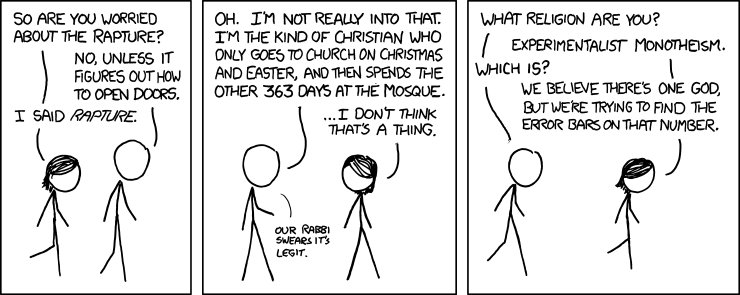
The latest xkcd:
(Mouse-over text: But to us there is but one God, plus or minus one. --1 Corinthians 8:6±2.)

The first panel is really the funniest bit: a pun on raptor (referencing the Jurassic Park movie). But in fact, rapture and raptor are not only phonologically similar, they're also etymologically related: both deriving from Latin rapt-, the past participial stem of rapere "to seize, to snatch, to carry off".

Also from Latin rapere are subreptitious "snatching under", rapacious "(greedily) snatching (with the intent to eat)", and rape (originally "carrying off", then "carrying off, esp. with the intent of sexually despoiling", later coming to refer specifically to "forced sexual intercourse").

Raptor in classical Latin meant "robber, thief", which is its meaning also in early English, later on in English it can also mean "rapist". From the 18th century, it was applied to "birds of prey", whence its later extension to refer to a particular "dromaeosaurid dinosaur", the Velociraptor "swift seizer".

Rapture, on the other hand, is not found in classical Latin, though it does appear in mediaeval Latin. The earliest citation the OED provides is from an 8th-century British text, in the form raptura, referring to "poaching". Its use in English, however, originally is confined to the sense (attested from the 16th century) of "extreme joy, intense delight". Though it was also used in the 17th and 18th centuries to refer to the "carrying off" or "rape" of women.

And not until the 18th century does rapture acquire its Millenarial sense (associated with ideas originally advanced by the Puritans Increase and Cotton Mather in Massachusetts). The word rapture in this Millenarial philosophy apparently picks up on the Latin word rapiemur (from rapere, see above) used in 1 Thessalonians 4:17 to refer to the faithful being "carried up" into the air (to meet Christ) in the Latin Vulgate:
deinde nos qui vivimus qui relinquimur simul rapiemur cum illis in nubibus obviam Domino in aera et sic semper cum Domino erimus
The Latin Vulgate of course is a translation of the Koine Greek text, and in this passage Latin rapiemur glosses the Greek ἁρπαγησόμεθα "we shall be caught up":
ἔπειτα ἡμεῖς οἱ ζῶντες οἱ περιλειπόμενοι ἅμα σὺν αὐτοῖς ἁρπαγησόμεθα ἐν νεφέλαις εἰς ἀπάντησιν τοῦ κυρίου εἰς ἀέρα: καὶ οὕτως πάντοτε σὺν κυρίῳ ἐσόμεθα.
Interestingly, Greek ἁρπάζω "catch up, snatch up"---of which ἁρπαγησόμεθα is the first person plural future passive indicative form---originates from the same Proto-Indo-European root as the Latin rapere which St Jerome uses to gloss it: PIE *h1rep- "to snatch" (also the source of English reap).


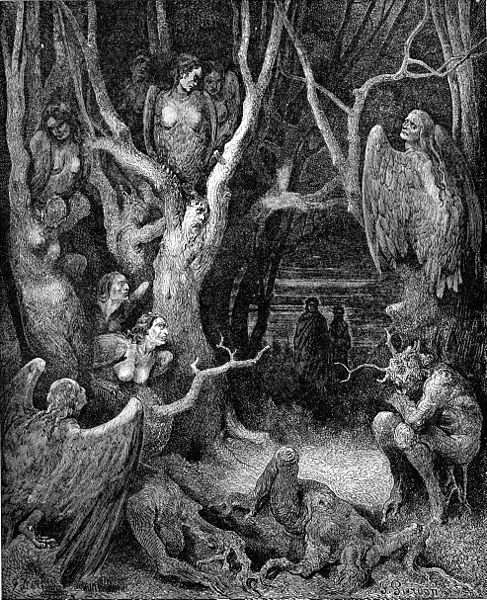
From the same Greek root as ἁρπάζω "catch up" is the word which comes into English as harpy: Greek ἅρπυια "the snatcher". So, with that, I leave you with some Harpies to flavour your Rapturous visions, courtesy of Gustave Doré:

[Edit (20 May 2011): Now see Mark Liberman's "No Word for Rapture" on Language Log for further etymological discussion of rapture.]

Wednesday, 23 March 2011

Linguistics Behind the Wicket (LBW) #1: Shahid Afridi and Free Love Friday

In belated celebration of the breaking of Australia's 34-match unbeaten run in World Cup matches by Pakistan, I offer the first in what I plan to be a recurring series of cricket-related linguistic investigations. I'm dubbing this series LBW ("Linguistics Behind (the) Wicket").

Shahid Afridi after the 2011 World Cup Pakistani victory over Australia
Shahid Afridi during the Pakistani World Cup 2011 match with Australia

This first investigation is a study in onomastics, taking as its subject the name of the skipper of the Pakistan team: Shahid Afridi (Urdu: شاہد آفریدی). To find out the connection between Afridi and free, "love", and Friday, read on!

[A brief word about the sources of Hindi/Urdu words: alongside of the native Indo-Aryan vocabulary (inherited, ultimately, from a vernacular cousin of Sanskrit), both the Hindi and Urdu varieties of Hindi/Urdu employ a large number of Persian and Arabic words (as a result of the Mughal invasion of India).]

Shahid (Hindi: शहीद; Urdu: شاہد) is an Hindi/Urdu word of Perso-Arabic origins, meaning "martyr" (religious or political). It derives ultimately from an Arabic root شہد, which Platts[1] glosses as meaning "to give testimony". Not being a semiticist, I cannot offer any further interesting discussion.

It is rather the name Afridi (Hindi: आफ़्रीदी; Urdu: آفریدی) which is of more interest for me. Jokingly, I have sometimes referred to Afridi as "Afriti", since his aggressive cricketing (Afridi holds the record (37 deliveries) for fastest century in one-day cricket) and mercurial temperament is suggestive of an Arabian Afreet (an angry sort of djinn): Arabic ʻIfrīt عفريت, pl. ʻAfārīt عفاريت. [The origin of this word is rather opaque to me: Platts[1] derives it from an Arabic root عفر meaning "to roll in the dust"; the Wikipedia article suggests that it comes from عفرت (`afrt) meaning "the evil"; the translation of the Qur'anic passage, Sura An-Naml (27:39-40) seems gloss it as "strong one". Maybe semiticists could enlighten me here?]

However, Āfrīdī, in fact, has no connection with Arabic "Afreet". Rather, it is a word of Iranian origin, which, being the name of a certain Pathan tribe, is thus presumably indicative of Shahid Afridi's ancestral origins.
afridi soldiers
Some afridis in the Khyber Rifles

In terms of its etymology, the word āfrīdī can be derived from the Persian word آفريده āfrīda, which means "creature" (noun) or "created" (adjective). (The āfrīdīs are thus perhaps "the created people".)

Āfrīda itself can be derived as the past/perfect participial form of the Avestan root frī- "love" combined with the prefix ā- (theoretically contributing a sense of "near, towards", but sometimes resulting in idiosyncratic meanings). Avestan āfrīda would corresponds to Sanskrit āprīta, both meaning "gladdened, joyous" etc.

The semantic change from Avestan "gladdened, joyous" to Persian "created" is intriguing. The earlier meaning of "joy" still seems to be present in Persian (and Hindi/Urdu) āfrīn/āfirīn, which can be used to mean "bravo! well done!" (though it too can have the "create" sense, at least in the compound jahān-āfirīn "creator of the world").

The root underlying both Sanskrit āprīta and Avestan āfrīda is Proto-Indo-Iranian *prī-, which itself can be traced back to the Proto-Indo-European root *prī- whose most basic sense is "to love".

The PIE root *prī- (see Watkins[2]) is also the source of English free (from Old English frēo, derived from the verb frēon "to love, to set free"), friend (from Old English frēond "friend, lover"), and Friday (from Old English Frīgedæge "Frigg's day", where Frigg, the name of the Scandinavian goddess of love, Odin's wife, derives from Proto-Germanic *frijjō "beloved, wife"); as well as Old English frioðu "peace", which sadly has no direct reflexes in modern English.

In fact, PIE *prī- underlies not only the Persian tribal name Afridi, but also a variety of Germanic-derived names (see Watkins[2]), including:
  1. Siegfried, from Old High German Sigi-frith "victorious peace"
  2. Godfrey, from Old High German Goda-frid "peace of god"
  3. Frederick, from French Frédéric, itself a borrowing of Old High German Fridu-rīh "peaceful ruler"
  4. Geoffrey, from Old French Geoffroi from mediaeval Latin Gaufridus, itself a borrowing from Germanic *Gawja-frithu- "(having a) peaceful region"
Thus perhaps Geoffrey Boycott can mention his "prī-" connection with Shahid Afridi if he ever needs some filler material when commentating a Pakistan match...

So, this concludes the first LBW. I'm open to suggestions for other cricketers or cricket terminology to etymologise for future episodes.

Bibliography:
[1]Platts, John T. 1884. A dictionary of Urdū, classical Hindī, and English. London: W. H. Allen & Co., 1884. (Reprinted, New Delhi: Munshiram Manoharlal, 2000.) [online]
[2]Watkins, Calvert. 2000. The American Heritage dictionary of Indo-European roots. Boston: Houghton Mifflin, 2nd edn.
[3]McGregor, R.S. 1993. The Oxford Hindi-English dictionary. Oxford: Oxford University Press. (Indian edition: New Delhi: Oxford University Press, 1994.)

Thursday, 10 February 2011

Minecræft. (Minakraft?)

The biggest indie game of 2010: Minecraft. Since it shares half a compound noun with the title of this blog, that seems as good an excuse as any to look at the "etymology" of Minecraft.

First, in case you're unfamiliar with Minecraft, here's a video:


In terms of Minecraft's design inspiration, its creator, Markus "Notch" Persson, attributes its origins to Infiniminer, Dungeon Keeper, Left 4 Dead, and Dwarf Fortress (the last has been described as a mixture of Nethack, Oregon Trail, The Sims, and Lemmings).

Etymology 1: "the art of mining"
If Minecraft were truly parallel to stæfcræft, then it would be what is referred to in Sanskrit grammar as a tatpuruṣa (तत्पुरुष) compound , that is, a compound of the form YX, where X is the head noun and Y relates to X as if it were some non-nominative case form, e.g. a genitive, dative, etc. For example, the tatpuruṣa compound mousehunter is a hunter (=X) of mice (=Y). If this were the case then Minecraft would mean something like "the craft of mining", i.e. "the art of mining",---which in fact is an analysis which makes eminent sense, given that mining is a major component of the game.


Etymology 2: "mining and crafting"
Another possibility, however, is that Minecraft is what is referred to in Sanskrit grammar as a dvandva (Sanskrit द्वन्द्व dvandva 'pair') compound, that is a compound of the form YX, where X and Y could be otherwise expressed as X and Y. For example, the dvandva compound producer-director (duo) is someone who is a producer and a director a pair of people, one of whom is a producer, and one a director [examples: (1), (2), (3), (4)]. This would also seem a plausible analysis, given that aside from mining, crafting items is the other major component of the game (well, alongside trying not to get eaten by zombies or blown up by creepers).


An excursus on mine and craft
A third possibility, which presents itself in view of the fact that the game's creator, Persson, is Swedish, is that it is indeed a tatpuruṣa compound, but a Swedish compound rather than an English one. To explore this possibility, it's worthwhile to delve deeper into the etymologies of mine and craft.

Mine, in English, derives from an Anglo-Norman word mine, which was more or less a form of Old French (the word mine is found c1220 in Old French with sense 'underground cavity or excavation where metals and minerals are found'). The Old French/Anglo-Norman word itself was most likely borrowed from some continental Celtic language (compare Welsh mwyn 'mineral, mine' (14th cent.); Old Irish méin 'ore, metal'; Scottish Gaelic mèinn 'ore, mine'; further etymology of the Celtic words is uncertain). A Swedish cognate, mina, is attested from the 17th century; cognate forms appear in other Scandinavian and Germanic languages, as well as in other Romance languages (Spanish, Portuguese, etc.), but all appear to ultimately be borrowings from the French. The Scandinavian words are likely to have been borrowed from German Mine (itself, of course, also originally borrowed from the French word).

Craft is an interesting word. Like mine its ultimate ancestry is uncertain (i.e. there is no obvious reconstructable Proto-Indo-European source for either mine or craft), it appears only in Germanic, with no apparent cognates in other Indo-European languages. The origin sense of craft is "power, might, strength". This was one of the prevalent senses of craft in early English (the last attestation in the Oxford English Dictionary for this sense is from 1526, W. Bonde Pylgrimage of Perfection ii. sig. Kviii, "By the craft [=power] of nature."), and this is in fact the only sense borne by its cognates in other Germanic languages.

Etymology 3 ("the Swedish etymology"): "the power of the mine"
The development into the more familiar English senses of craft, e.g. "skill, art" is a solely English development---though it took place very early in English, as evidenced by an abundance of words in Old English of the type stæfcræft ("skill of letters; grammar"). This development seems to have involved a metaphorical extension of craft's original sense "(physical) power" as "intellectual power" and therefore "ability, skill, art". Thus, its Swedish cognate, kraft, has only the more original sense "power, might, strength". Therefore, if Minecraft were to be actually be a Swedish coinage (or, at least, an anglicisation of such a compound, which, I think, would have been Minakraft), then it could be treating as a (tatpuruṣa) compound meaning something like "power of the mine".


The real etymology
However, none of these proposed etymologies appear to in fact be correct. Persson on his blog (14 May 2009) originally proposed to call the game "Minecraft: Order of the Stone", a name "awesome but insane people in #tigirc helped [him] come up". Further investigation reveals that "[it was] RinkuHero...who suggested "Minecraft" (as an analogy to "Starcraft"), having not played the game and knowing nothing about it other than that it was a type of strategy game involving mines."

So Minecraft is simply an analogical form based on Starcraft (Starcraft is a game having to do with stars, and therefore a game having to do with mines is Minecraft). Now, Starcraft itself appears to be analogical form based on the title of one of Blizzard Entertainment's other games(/game franchises): Warcraft. If the compound type (tatpuruṣa) is carried over in the analogical process, then, in a sense, Minecraft should indeed mean something like "art of mining", which was the first of the proposed etymologies.


Miscellany: wars and crafts
The word warcraft itself is of course not a new coinage specific to the Blizzard Entertainment series. Interestingly though, warcraft does appear to be a relatively recent coinage (recent compared to the history of English at least), with the Oxford English Dictionary's earliest citation being from around 1660 (T. Fuller Worthies (1662) Lanc. 124 "Duke Hambleton‥had Officers who did Ken the War-craft, as well as any of our Age."). Though warcraft itself appears relatively late in the history of English, there are earlier formations ending in -craft which bear the same meaning that appear in Old English, including beaducræft(ig), gūðcræft, and wīgcræft (the last is the most widespread; the first two occur only in Beowulf).

Incidentally, war is a word with a weird history, it's a "returnee"-type borrowed word: it derives from a Germanic word, borrowed into French, and thence "given back" to English (a Germanic language). [It appears in late Old English (c1050) in the form wyrre, werre, a word borrowed from North-eastern Old French werre (cp. modern French descendant, guerre "war") which itself was borrowed from Old High German werra "confusion, discord, strife", related to the Old High German verb werran "to bring into confusion or discord" (cp. modern German wirren "to confuse, perplex"), ultimately from a Proto-Germanic root *werz-, *wers-, which is the origin also of the modern English word worse.] 


Anglo-Saxon Minecraft
Returning to Minecraft: what---you didn't ask---would be the Old English form of Minecraft, given that we have determined that it must mean "art/skill of mining"? Probably Delfingcræft.

Thus, on that note, we close with some gratuitous screenshots of Heorot, the famous meadhall of Beowulf, as constructed in Minecraft:


Thursday, 16 September 2010

Philology and (La)Tex: on Proto-Indo-European dragon-slaying and Hittite ḫ

A couple of years ago I made the switch from Word to LaTex. At the time I was in the middle of writing a paper on formulaic language in Proto-Indo-European, specifically working on the reconstruction of formulae connected with the PIE dragon-slaying mytheme. Though the (first draft of the) paper was mostly written, I decided I would reset it in LaTeX. This was a rather labourious task, but resulted in much more aesthetically-pleasing document, and LaTeX allows for a much easier system of referring to numbered examples than does Word (amongst other benefits of the LaTeX type-setting system). [I use Wolfgang Sternefeld's linguex package for example numbering.]

As this was a philological paper dealing with a number of different languages (Old Irish, Old English, Old Saxon, Gothic, Vedic Sanskrit, Classical Greek, Avestan, Pahlavi, and Hittite), special diacritics and characters were required. Rei Fukui's TIPA package handles almost all of the characters/diacritics which were needed. The one exception was the Hittite "laryngeal ḫ" and polytonic classical Greek.

I. How to typeset Hittite ḫ in LaTeX:
The character ḫ may be defined by the following macro (assuming that the TIPA package has been loaded in the preamble by \usepackage{tipa}):
\newcommand{\hith}{\tipaLoweraccent[+.1ex]{\u{}}{h}}
Then whenever ḫ is required, it may be called via the command {\hith}, as in the following text:
n=an=za namma \super{\sc{mu\v{s}}} illuyanka$[$n$]$ tara{\hith}{\hith}\={u}wan d\=ai\v{s}
which results in:
n=an=za namma MUŠilluyanka[n] taraḫḫūwan dāiš
(meaning "He (the storm god) began to overcome the serpent"; from KBo. 3.7 iii 24-5)

II. How to typeset classical Greek in LaTeX:
In the philological tradition, the only language using a non-Latinate script which is not transliterated is Greek (I've always found this a bit unfair: why isn't Sanskrit rendered in Devanagari?). To typeset polytonic (ancient) Greek in LaTeX, we'll need the following packages: babel, teubner, fontenc, cbgreek. Defining a macro \greekfont then allows us to switch to polytonic Greek.

A minimal example illustrating the usage:
\documentclass{article}
\usepackage[polutonikogreek,latin,english]{babel}
\usepackage{mathptmx} %OPTIONAL, in order to set Latin/English in Times font
\usepackage[T1]{fontenc}
\usepackage{teubner}
\usepackage{tipa} %OPTIONAL, for typesetting diacritics/special characters for other lgs.


\newcommand{\greekfont}[1]{\fontencoding{LGR}\fontfamily{cmr}\selectfont\foreignlanguage{greek}{#1}\normalfont}


\begin{document}
{\noindent}From Pindar's \textit{Olympian} 13.63--4:
{\noindent}\greekfont{\Ar{o}c t\cap{a}c \s{o}fi\'hdeos u\r{i}\'on pote Gorg\'onos \cap{\s{h}} p\'oll> \s{a}mf\`i krouno\cap{i}c\\P\'agason ze\cap{u}xai poj\'ewn \Gs{e}pajen}
\end{document}

produces:


(meaning "who (rel. pro.) beside the Springs, striving to break the serpent Gorgon's child, Pegasos, endured much hardship")

You'll need to make sure you have the full cbgreek package, otherwise the Greek font will be blurry and ugly.

III. Post scriptum
Here's the rub (of course): having produced a beautifully typeset document, I submitted it to Historische Sprachforschung (Adalbert Kuhn's old Zeitschrift für vergleichende Sprachforschung). It was accepted, but the journal could only process Word documents. So I had to go back and retypeset the whole thing in Word (again). This involved a lot of using find-and-replace (to turn LaTeX code/macros into Unicode characters or Word formatting or example numbers etc.) Unfortunately, this almost meant that the table I had managed to fit on a single page (in order that the various formulae could be easily compared) using smaller font sizes and rotating it horizontally using the package lscape, thus


is in HS split across three pages...

Happily, the original LaTeX-produced version did in fact appear earlier in Studies in the Linguistic Sciencies: Illinois Working Papers 2009 (who do accept LaTeX submissions (since I designed a LaTeX style file for the journal...)).


References:

[1] Slade, Benjamin. 2008[2010]. How (exactly) to slay a dragon in Indo-European? PIE *bheid- {h3égwhim, kwŕ̥mi-}. Historische Sprachforschung 121: 3-53. [link]
[2] Slade, Benjamin. 2009. Split serpents and bitter blades: Reconstructing details of the PIE dragon-combat. Studies in the Linguistic Sciences: Illinois Working Papers 2009: 1-57. [link]

Tuesday, 3 August 2010

Computational approaches to understanding language evolution [video]

In her recent ILLS talk, Tandy Warnow discusses computational approaches for inferring language evolution and linguistic relationships:

Computational methods for inferring evolutionary histories of languages

A page with links to various publications associated with this project (and the datasets used) is available here: http://www.cs.rice.edu/~nakhleh/CPHL/.

One of the interesting points of this study is the relationship of Germanic with respect to the other branches of Indo-European. Germanic, at least when the morphological data is given more weight, is not particularly closely related to Italic or Celtic, though it shares a number of lexical similarities with these groups. This is suggestive of a later migration of Germanic-speaking peoples into an area where they came into contact with Italo-Celtic speakers. In any case, it's an interesting approach to historical data.


For more ILLS2 videos, see this link: http://ills.linguistics.illinois.edu/current/showcase.html.

Friday, 18 December 2009

Overstand the downpression of the kin-dread by outformers: On what to call "reverse eggcorns" in Dread Talk

The language of reggae music is filled with examples of linguistic creativity, including what we might call "puns". One example is Rastafari reanalysed as Rasta Far Eye. Tafari was Haile Selassie I's pre-king name, and since he was of Ethiopian nobility he had the title Ras, an Amharic word roughly translatable as "prince". One of the central tenets of the Rastafarian movement (which obviously takes its name from Ras Tafari) is that Haile Selassie I is an incarnation of God (Rastafarian Jah, cp. Yahweh). Rastafari is thus (intentionally/knowingly) reanalysed as "far-seeing Haile Selassie I/God/Jah".

Another interesting example of this sort is found in the lyrics and title of the song "Kin Dread" (Midnite[1]):


Here singer/lyricist Vaughn Benjamin intentionally reanalyses kindred as kin-dread, and, amusingly, he appears to overtly reference this linguistic remaking, as towards the end of the song (~5.00) he says:
Well, how come family mean "kin" and "dread"? Enough with them the vernacular etymological syntax.
Does vernacular etymological syntax = "folk etymology"?

Kindred historically derives from OE. cynn-rǣden: cynn "family, race, blood-relations" (OED[2]) and rǣden "condition, reckoning" (modern English read and riddle come from the same root); the -d- of kindred is epenthetic (cp. Modern English thunder from OE. þunor, ME. þoner).

Benjamin's reanalysis of kindred as kin-dread I assumed would mean something like "fellow Rastafarians" (dread can mean "Rastafarian"; from dreadlocks, "uncut, unwashed, uncombed hair worn 'in dread of the Lord' [cf. the Nazarite vow]"), but from the context of the song it seems to simply bear the standard sense of kindred, metaphorically extended as "fellow human beings", since it is obvious that usually the kin-dread he refers to are not necessarily fellow Rastafarians, as shown by:
Hear a small story, me a-tell you a sad story about a farmer. Planted the most italful garden, but [the youth them]i only want soft drinks in Babylon-flavour. But yeah, you know, themi are me kin-dread.... Full-fledgèd.
[Babylon is a standard Rastafarian term for "(corrupt) western society". Ital (cf. italful) is roughly "kosher (for Rastafarians)", excluding tobacco, alcohol, pork (and often meat altogether), and preservatives/artificial ingredients (and thus soft drinks....).]


Examples like Rasta-Far-Eye and kin-dread appear to be largely nonce-formations, akin to puns. However, Rastafarian English (or what Pollard[3] calls "Dread Talk", defined as an example of "lexical expansion within a creole system" [2:24]) is full of entrenched examples of remakings which are similar to (though not typically paronomastic in the same way as) kin-dread and rasta-far-eye.

Pollard[3:24,46] refers to such examples as "Category II: words which bear the weight of their phonological implications". I'm not sure that this is the clearest definition or the best analysis of the linguistic change involved in such remakings. Let's examine the some of the most common of these entrenched reanalyses:
Downpress(ion) = "oppress(ion)"
Overstand = "understand"
Outformer = "informer"
Livicate = "dedicate"
Blindgarette = "cigarette"
All of these involve remakings which seem add or remove a pejorative sense (as appropriate):
Oppress treated as if up-press (though really from Latin ob- "against" + premere "press"). Uppress would seem to mean "lift up"; thus reformed as down-press.

Understand is of somewhat obscure origins. Other Germanic languages use stand with other prefixes for the same sense (cp. German vorstehen, as if English forstand). The prefix perhaps reflects not PIE *ndher "under" (cp. Latin infrā), but rather PIE *nter "between, among" (cp. Latin inter), see further Liberman[4:210-5]. Whatever the etymology, other words in modern English with the prefix under- tend to indicate either "subordinate", e.g. underling, or "insufficient", e.g. underfunded; thus understand is reanalysed as "low comprehension, insufficient comprehension", and remade as overstand.

Informer: in often has positive connotations (e.g. in-group); out negative ones (e.g. outsider); thus remade as outformer (cp. perhaps to rat (s.o.) out).

Dedicate actually from Latin dē "out" + dicāre "say, proclaim", but analysed as if connected with English dead (with negative connotations); so remade as livicate (from live).

Cigarette: analysed as see-garette, where see has positive connotations (cp. above Rasta-Far-Eye), but tobacco is considered by Rastafarians as polluting/unclean; thus reformed as blind-garette.
These reanalyses are reminiscent of folk etymology or eggcorns (see also Liberman[5], Pullum[6], Zwicky[7]), but unlike eggcorns they appear to be intentional. That is, Rastafarians obviously recognise that in standard English people say oppress, understand, informer, dedicate, cigarette etc., and thus these aren't misunderstandings like elk for ilk. And they don't seem to be what Zwicky[8] calls "mock eggcorns". Rather the above remakings involve an intentional re-etymologising, as if the standard English forms were the eggcorns.

What do we call this sort of morphological/semantic change?

("Reverse eggcorn" is the best I have, but that doesn't seem quite right.)

References:
[1]Midnite. 2006. Jah Grid. Christiansted, St.Croix (US Virgin Islands): I-Grade Records.
[2]The Oxford English Dictionary, September 2009 rev. ed.
[3]Pollard, Velma. 2000. Dread Talk: the language of Rastafari. Kingston, Jamaica & Montreal, Canada: Canoe Press & McGill-Queen's University Press, rev. ed.
[4]Liberman, Anatoly. 2008. An analytic dictionary of English etymology: an introduction. Minneapolis: University of Minnesota Press.
[5]Liberman, Mark. 2003. "Egg corns: folk etymology, malapropism, mondegreen, ???" Language Log. September 23, 2003.
[6]Pullum, Geoffrey K. 2003. "Phrases for lazy writers in kit form." Language Log. October 27, 2003.
[7]Zwicky, Arnold. 2003. "Lady Mondegreen says her peace about egg corns." Language Log. November 02, 2003.
[8]Zwicky, Arnold. 2009. "Mock eggcorns and their kin". Arnold Zwicky's blog. August 29, 2009.

Monday, 30 November 2009

Nother post on nor

A recent Language Log post discusses the use of nor in the sentence:
"The snow fell nor did it cease to fall."
Since this topic touches on disjunction and ultimately on wh-words (interrogative pronouns), central issues in my dissertation, I can (almost) justify taking the time to investigate some of the antecedents of McCarthy's use of nor. Nor in the above sentence, as Mark Liberman observes, conforms to the sense in the OED's[1] entry 5a. for nor:
5. And — not; neither. In later use normally with inversion of subject and verb.

a. Following an affirmative clause, or in continuing narration. Obs. (chiefly poet. in later use).
Liberman offers discussion of modern and (late) early modern English examples in the aforementioned Language Log post; I shall concentrate on earlier examples, such as:
[1423] Guildhall Let.-bk. in R. W. Chambers & M. Daunt Bk. London Eng. (1931) 114 He shalle wirke..without fraude..nor he shall nat entermete of sekenes, sore, or hurte..vnknowynge to hym in eny maner.

[1492-3] in T. Pape Medieval Newcastle-under-Lyme (1928) 180 The aforesaid William shall delyuer all evedence and writings that belonges to the lands in the Newcastle, nor hurt nor truble the aforesaid John Leighton.

[1523] LD. BERNERS tr. J. Froissart Cronycles I. cxxxv. 162, I greatly desyre to se the kynge my maister, nor I wyll lye but one nyght in a place, tyll I come there.
These are the three earliest examples the OED gives for sense 5a. It is interesting to note that the first two appear to come from legal documents.

The OED suggests that nor derives from earlier nother1 (a contracted form of Old English nōhwæðer "neither", on which more presently), for which its earliest example means "neither of two preceding things or persons":
[eOE] KING ÆLFRED tr. Gregory Pastoral Care (Hatton) li. 399 Ne fornime incer noðer oðer ofer will butan geðafunge.
"Let neither of you deprive the other without consent."
As Mitchell[2]:§§1847-51 observes, OE nohwæðer/noðer cannot always be interpreted as a pronoun, as in:
[Blickling Homilies[3]:45.14]...þæt hi þonne ne mihtan nawþer ne him sylfum ne þære heorde þe hi ær Gode healdan sceoldan, nænige gode beon.
"[For the good teacher has said that, when the priest or bishop was led into eternal perdition,] that they could not be any good, neither for himself nor for the flock which they previously should have kept for God.",
where it plays a similar role to modern English neither.

This nother1 is not to be confused with a nother [sic] development which led to a form nother: namely the reanalysis of another/an other as a nother2, for which we find early examples such as:
[c1390] MS Vernon Homilies in Archiv f. das Studium der Neueren Sprachen (1877) 57 280 He wolde him say his onswere on a noþer day.
And, of course, this nother2 is frequent in the collocation (that's) a whole nother story, but it may be found outside of this formula, as in:
[1977] C. MCFADDEN Serial (1978) xxviii. 62/2 I'm in a whole nother space.
[1993] Wired Dec. 18/3 A new direction and a new name seem inevitable. But ‘tekkies?’ It seems too much like ‘Trekkies’, which invokes a whole 'nother set of connotations.
Interestingly, there is also a dialectal English (apparently particularly in Southwest England, if the prominence of Zomerzet zs in the last two examples is any indication) development which the OED suggests represents convergence between nother1 and nother2:-- neither nother, originally "neither one nor another", and thence "no other":
[?a1425 (c1380)] CHAUCER tr. Boethius De Consol. Philos. V. met. iii. 52 Who so that sekith sothnesse, he nis in neyther nother habit, for he not nat al, ne he ne hath nat al foryeten.
[1533] T. MORE Apologye 180 There are fewe or none good in neyther nother parte.
[1640] R. BROME Sparagus Garden IV. v, No sir, we come with no zick intendment on neither nother zide.
[1888] F. T. ELWORTHY W. Somerset Word-Bk. 523 There idn nother-nother lemon vor to be had in the town, nit vor love nor money, zo Mr. Baker zess.
Neither nother is also prominent in West Indian English, with the sense "no other":
[1957] F. A. COLLYMORE Notes for Gloss. Barbadian Dial. (ed. 2) 59, I ain't got neither-nother sixpence.
[1975] T. CALLENDER It so Happen 99 He never going look at neithernother girl again.
Nother1 also appears with the OED's nor sense 5a., as far back as the Old English of Beowulf:
Swā wē þǣr inne andlangne dæg
nīode nāman oð ðæt niht becwōm
ōðer tō yldum; Þā wæs eft hraðe
gearo gyrnwræce Grendeles mōdor
sīðode sorhfull; sunu dēað fornam,
wīghete Wedra; wīf unhӯre
hyre bearn gewræc; beorn ācwealde
ellenlīce; þǣr wæs Æschere
frōdan fyrnwitan feorh ūðgenge.
Nōðer hӯ hine ne mōston syððan mergen cwōm
dēaðwērigne Denia lēode
bronde forbærnan nē on bǣl hladan
lēofne mannan; hīo þæt līc ætbær
fēondes fæðme under firgenstrēam;
þæt wæs Hrōðgāre hrēowa tornost
þāra þe lēodfruman lange begēate.
Beowulf ll.2115-30
"We were happy therein all day long,
and enjoyed ourselves, until another
night descended on man. Then suddenly
Grendel's mother, ready to revenge her sorrow,
journeyed, sorrowful--- death had taken her son,
the war-hate of the Wederas [=Beowulf]. The ghastly woman
avenged her child, slew a warrior
boldly. Thus from Ashhere,
the wise counsellor, life departed.
Nor could the Danish people, when morning came,
cremate the dead one in the fire,
could not lay on the funeral pyre
the body of the beloved man: she had carried off the corpse,
held in fiend's embrace, beneath the mountain-stream.
That was for Hrothgar the most bitter grief
which had long befallen the ruler of the people."
Thus this use of nother1/nor (in the OED sense 5a. for nor) appears to have a long history in English. [Additional note: Nōðer here does not seem to mean "neither", in the sense "neither...nor", despite the present of nē in the sentence (see this comment on Languagelog), since on bǣl hladan "lay/load (his body) on the pyre" is really just a variation of bronde forbærnan "cremate in the fire" --- these aren't two different funerary options that the Danes have. But see this post for what is perhaps a clearer example from The Fortunes of Men.]

Old English nōhwæðer, originally a pronoun meaning "neither of two persons or things", from which nother1 (OE nōðer) derives, is itself etymologically-interesting. Nōhwæðer is morphologically composed of ne "not" + ā/ō "always" + hwæðer "whether". Without ne we find āhwæðer (with contracted forms āwðer, ōwðer, āðer), with essentially the sense of modern English either:
[KING ALFRED, Trans. of Orosius, 290.21] Þa oferhogode he þæt he him aðer dyde, oþþe wyrnde, oþþe tigþade...
"Then he scorned to do either, forbid it or grant it..."
More interesting is the original sense of hwæðer (ancestor of modern English whether): "which of two", as illustrated by Beowulf's speech to his men before his fight with the dragon:
'Gebīde gē on beorge byrnum werede
secgas on searwum hwæðer sēl mæge
æfter wælrǣse wunde gedӯgan
uncer twēga; nis þæt ēower sīð
nē gemet mannes nefne mīn ānes.'
Beowulf, ll.2529-33
"'Wait you here in the barrow, wearing mailcoats,
warriors in armour, (and see) which of the two can better,
during the slaughter-race, survive wounds,
of the two of us; this is not your adventure,
nor in the power of any man, save mine alone.'"
The predominant modern use of whether for introducing indirect yes/no questions was originally only one of its many functions, which including introducing alternative questions (note that, like other wh-words, in matrix questions it triggers verb-raising to the second-position):
[c1000] Ags. Gosp. Matt. xxi. 25 Hwæðer wæs iohannes fulluht, þe of heofonum, þe of mannum?
"Was John's baptism from heaven or from man?"
[1595] SHAKES. John I. i. 134 Whether hadst thou rather be a Faulconbridge,..Or the reputed sonne of Cordelion?
[1713] BERKELEY Hylas & Phil. I. (1725) 5 Whether does Doubting consist in embracing the Affirmative or Negative Side of a Question?
[a1822] SHELLEY Ion Pr. Wks. 1888 II. 115 Whether do you demonstrate these things better in Homer or Hesiod?
As well introducing as indirect alternative questions:
[c1000] ÆLFRIC Hom. II. 120 Eft ða Gregorius befran, hwæðer þæs landes folc cristen wære ðe hæðen.
"Then Gregorius asked whether the people of the land were christian or heathen."
[1610] SHAKES. Temp. V. i. 123 Whether this be, Or be not, I'le not sweare.
[1849] MACAULAY Hist. Eng. iv. I. 464 His neighbours might well doubt whether it were more dangerous to be at war or at peace with him.
The modern function as introducing indirect yes/no questions is attested early as well:
[c1000] Ags. Gosp. Matt. xxvi. 25 Cwyst þu, lareow, hwæðer ic hyt si?
"Do you say, teacher, whether it is I?"
[1470-85] MALORY Arthur VII. xx. 244 He mette with a poure man..& asked hym whether he mette not with a knyghte.
All of these functions can be seen to derive from the original sense "which of two". The morphological formation of hwæðer is curious however: it derives from Proto-Germanic *χwaþaraz (with cognates in other Germanic languages, e.g. Old Frisian hwedder, Old Saxon hweðar, Old High German hwedar, Old Norse hvaðarr (> Swedish hvar), Gothic hwaþar), which itself can be traced to PIE *kwo- "what, who etc." + the comparative suffix *-tero-.

What is curious is the use of the comparative suffix: all of these forms would literally be something like "what-er" ("more what")! (Though of course, since hwæðer etc. are used to inquire about "which of two", the comparative suffix, which compare two things, does make a certain amount of sense.)

Proto-Germanic *χwaþaraz has cognates in other old Indo-European languages, e.g. Greek πότερος, and Sanskrit katará-, the latter is found for example in the Rgvedic hymn on "Heaven and Earth":
katarā́ pū́rvā katarā́parāyóḥ
RV 1.185,1a
"Which of the two is earlier, which of the two is later?"
In Sanskrit, the interrogative pronoun can also combine with the superlative suffix (PIE *-temo-), to mean "which amongst many", as in the following Rgvedic passage praising Varuṇa:
kásya nūnáṁ katamásyāmŕ̥tānām
RV 1.24,1a
"Who now is he? Which among the many immortals?" [Lit. "Whichest of the immortals?"]
We're now of course a long way from the snow fell nor did it cease to fall, but following nor back along the path to nother "neither of two", and then off on the side path of its component morpheme hwæðer (mod. Engl. whether) "which of two", originally "what-er"(!), seemed an interesting enough detour.

References:
[1]The Oxford English Dictionary, September 2009 rev. ed.
[2]Mitchell, Bruce. 1985. Old English syntax. 2 vols. Oxford: Clarendon.
[3]Morris, Rev. R. 1880. The Blickling Homilies of the tenth century. London: Early English Text Society.
[4]Graßmann, Hermann. 1873. Wörterbuch zum Rig-Veda. Wiesbaden: Harrassowitz.