Wednesday, 23 March 2011

Linguistics Behind the Wicket (LBW) #1: Shahid Afridi and Free Love Friday

In belated celebration of the breaking of Australia's 34-match unbeaten run in World Cup matches by Pakistan, I offer the first in what I plan to be a recurring series of cricket-related linguistic investigations. I'm dubbing this series LBW ("Linguistics Behind (the) Wicket").

Shahid Afridi after the 2011 World Cup Pakistani victory over Australia
Shahid Afridi during the Pakistani World Cup 2011 match with Australia

This first investigation is a study in onomastics, taking as its subject the name of the skipper of the Pakistan team: Shahid Afridi (Urdu: شاہد آفریدی). To find out the connection between Afridi and free, "love", and Friday, read on!

[A brief word about the sources of Hindi/Urdu words: alongside of the native Indo-Aryan vocabulary (inherited, ultimately, from a vernacular cousin of Sanskrit), both the Hindi and Urdu varieties of Hindi/Urdu employ a large number of Persian and Arabic words (as a result of the Mughal invasion of India).]

Shahid (Hindi: शहीद; Urdu: شاہد) is an Hindi/Urdu word of Perso-Arabic origins, meaning "martyr" (religious or political). It derives ultimately from an Arabic root شہد, which Platts[1] glosses as meaning "to give testimony". Not being a semiticist, I cannot offer any further interesting discussion.

It is rather the name Afridi (Hindi: आफ़्रीदी; Urdu: آفریدی) which is of more interest for me. Jokingly, I have sometimes referred to Afridi as "Afriti", since his aggressive cricketing (Afridi holds the record (37 deliveries) for fastest century in one-day cricket) and mercurial temperament is suggestive of an Arabian Afreet (an angry sort of djinn): Arabic ʻIfrīt عفريت, pl. ʻAfārīt عفاريت. [The origin of this word is rather opaque to me: Platts[1] derives it from an Arabic root عفر meaning "to roll in the dust"; the Wikipedia article suggests that it comes from عفرت (`afrt) meaning "the evil"; the translation of the Qur'anic passage, Sura An-Naml (27:39-40) seems gloss it as "strong one". Maybe semiticists could enlighten me here?]

However, Āfrīdī, in fact, has no connection with Arabic "Afreet". Rather, it is a word of Iranian origin, which, being the name of a certain Pathan tribe, is thus presumably indicative of Shahid Afridi's ancestral origins.
afridi soldiers
Some afridis in the Khyber Rifles

In terms of its etymology, the word āfrīdī can be derived from the Persian word آفريده āfrīda, which means "creature" (noun) or "created" (adjective). (The āfrīdīs are thus perhaps "the created people".)

Āfrīda itself can be derived as the past/perfect participial form of the Avestan root frī- "love" combined with the prefix ā- (theoretically contributing a sense of "near, towards", but sometimes resulting in idiosyncratic meanings). Avestan āfrīda would corresponds to Sanskrit āprīta, both meaning "gladdened, joyous" etc.

The semantic change from Avestan "gladdened, joyous" to Persian "created" is intriguing. The earlier meaning of "joy" still seems to be present in Persian (and Hindi/Urdu) āfrīn/āfirīn, which can be used to mean "bravo! well done!" (though it too can have the "create" sense, at least in the compound jahān-āfirīn "creator of the world").

The root underlying both Sanskrit āprīta and Avestan āfrīda is Proto-Indo-Iranian *prī-, which itself can be traced back to the Proto-Indo-European root *prī- whose most basic sense is "to love".

The PIE root *prī- (see Watkins[2]) is also the source of English free (from Old English frēo, derived from the verb frēon "to love, to set free"), friend (from Old English frēond "friend, lover"), and Friday (from Old English Frīgedæge "Frigg's day", where Frigg, the name of the Scandinavian goddess of love, Odin's wife, derives from Proto-Germanic *frijjō "beloved, wife"); as well as Old English frioðu "peace", which sadly has no direct reflexes in modern English.

In fact, PIE *prī- underlies not only the Persian tribal name Afridi, but also a variety of Germanic-derived names (see Watkins[2]), including:
  1. Siegfried, from Old High German Sigi-frith "victorious peace"
  2. Godfrey, from Old High German Goda-frid "peace of god"
  3. Frederick, from French Frédéric, itself a borrowing of Old High German Fridu-rīh "peaceful ruler"
  4. Geoffrey, from Old French Geoffroi from mediaeval Latin Gaufridus, itself a borrowing from Germanic *Gawja-frithu- "(having a) peaceful region"
Thus perhaps Geoffrey Boycott can mention his "prī-" connection with Shahid Afridi if he ever needs some filler material when commentating a Pakistan match...

So, this concludes the first LBW. I'm open to suggestions for other cricketers or cricket terminology to etymologise for future episodes.

Bibliography:
[1]Platts, John T. 1884. A dictionary of Urdū, classical Hindī, and English. London: W. H. Allen & Co., 1884. (Reprinted, New Delhi: Munshiram Manoharlal, 2000.) [online]
[2]Watkins, Calvert. 2000. The American Heritage dictionary of Indo-European roots. Boston: Houghton Mifflin, 2nd edn.
[3]McGregor, R.S. 1993. The Oxford Hindi-English dictionary. Oxford: Oxford University Press. (Indian edition: New Delhi: Oxford University Press, 1994.)

Tuesday, 8 March 2011

Indian voices from 1913-1929: Gramophone Recordings from the Linguistic Survey of India

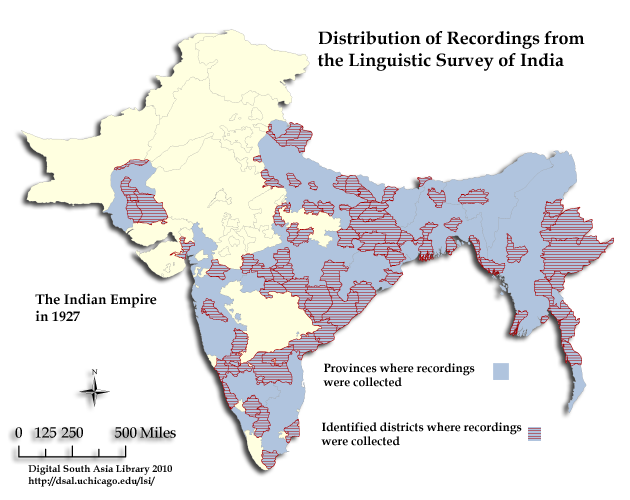
George Grierson pioneered the vast Linguistic Survey of India in 1894, an immensely useful resource for anyone working on languages of the Indian subcontinent. A set of recordings were also made as part of the survey, which were recently uncovered in the British Library. These recordings are now freely available from the University of Chicago's Digital South Asian Library at http://dsal.uchicago.edu/lsi/


In order that the languages might be more easily compared (and because "it contains the three personal pronouns, most of the cases found in the declension of nouns, and the present, past, and future tenses of the verb"), Grierson chose to use translations of the Biblical "Parable of the prodigal son", and many of the recordings are of speakers reciting this parable in their native language.

Here is the recording of the "Parable of the prodigal son":
  In Hindi (one of the major languages of India)
  In Khasi (a Mon-Khmer language spoken in Shillong, Meghayala, [the former capital of Assam])

OPEN Magazine has a great article about these recordings, their rediscovery and content, available here: Voices from Colonial India

It's well worth a read, but here are a few highlights. For instance:

Some of the Sanskrit recording took a bit of doings. Background: strict followers of the Vedic/Hindu tradition are supposed to safeguard the Vedas from the ears of those who are not dvijas ("twice-born", those who wear the sacred thread). This prohibition was taken seriously by some authorities, for instance, in the Gautama Dharma Sutra we find:
अथ हास्य वेदमुपशृणवतस्त्रपुजतुभ्यांश्रोत्रप्रतिपूरणमुदाहरणे जिह्वाच्छेदो धारणेशरीरभेदः
"Now if he [a Shudra = a non-dvija/untouchable] listens intentionally to (a recitation of) the Veda, his ears shall be filled with (molten) tin or lac.   [Gautama Dharma Sutra 12.4]
From the OPEN Magazine article:
...All of this, of course, could not have been accomplished without some Brahminical drama. The scholar Ganganath Jha, who was approached for the Sanskrit reading, was scandalised to learn that a mlechha [Sanskrit for "barbarian", "foreign devil", and thus by definition a non-dvija] would be privy to his chaste Sanskrit. A demand was made for a certifiably Brahmin gramophone operator. The Raj, almost as unbending as Brahmins, refused. A compromise was reached: Jha sat in a room and spoke into a large horn-like object that projected his voice into another room where the operator sat. Communication between the two was by means of a complicated system of switches to ensure that the operator didn’t physically hear the Sanskrit. And that was enough to assuage the Brahmin guilt about speaking Sanskrit into a device that held the power to broadcast it to the world...
Jha's recording must have been of some Vedic text, because I am unaware of any general prohibition against speaking Sanskrit in the presence of non-dvijas. Sadly, I cannot find this recording on the University of Chicago's Digital South Asian Library site (they do have a general entry for Jha here: https://coral.uchicago.edu:8443/display/lasa/Ganganath+Jha+Ken.+Sanskrit+Vidyapith+%28Allahabad%2C+India%29).

[Brahminical rationalisations can be both amusing and creative: My advisor, who is a (German) Sanskrit scholar, once told me about one spoken Sanskrit conference he attended (where, I believe, he was the only non-Brahmin/non-Indian) at which there was one attendee who was a bit unhappy with the presence of a non-Brahmin, and was careful not to let my advisor's shadow touch him... Other attendees came up with rationalisations: German sounds a bit like Sharma, a Brahmin surname, and so they theorised that Germans are perhaps "long-lost" Brahmins, and therefore my advisor's presence could be a acceptable.]

Another interesting bit from the OPEN Magazine article:
Many of the speakers chose to sing or recite poems or limericks. Particularly lingering is the voice of Hassaina of Delhi who has clips in the Ahirwati and Mewati languages. Who was this girl who sang with such sang-froid of love and waiting on 26 April 1920?  Nothing is known of her. She survives only as a voice.
Here is Hassaina's song: http://dsal.uchicago.edu/lsi/6838AK

[27 May 2011: Nepali is actually represented too, hidden under "Khaskura", including both the parable of the prodigal son translation, and a delightful song sung by a Shillongwala Nepali, Babu Dhan.]

Thursday, 10 February 2011

Minecræft. (Minakraft?)

The biggest indie game of 2010: Minecraft. Since it shares half a compound noun with the title of this blog, that seems as good an excuse as any to look at the "etymology" of Minecraft.

First, in case you're unfamiliar with Minecraft, here's a video:


In terms of Minecraft's design inspiration, its creator, Markus "Notch" Persson, attributes its origins to Infiniminer, Dungeon Keeper, Left 4 Dead, and Dwarf Fortress (the last has been described as a mixture of Nethack, Oregon Trail, The Sims, and Lemmings).

Etymology 1: "the art of mining"
If Minecraft were truly parallel to stæfcræft, then it would be what is referred to in Sanskrit grammar as a tatpuruṣa (तत्पुरुष) compound , that is, a compound of the form YX, where X is the head noun and Y relates to X as if it were some non-nominative case form, e.g. a genitive, dative, etc. For example, the tatpuruṣa compound mousehunter is a hunter (=X) of mice (=Y). If this were the case then Minecraft would mean something like "the craft of mining", i.e. "the art of mining",---which in fact is an analysis which makes eminent sense, given that mining is a major component of the game.


Etymology 2: "mining and crafting"
Another possibility, however, is that Minecraft is what is referred to in Sanskrit grammar as a dvandva (Sanskrit द्वन्द्व dvandva 'pair') compound, that is a compound of the form YX, where X and Y could be otherwise expressed as X and Y. For example, the dvandva compound producer-director (duo) is someone who is a producer and a director a pair of people, one of whom is a producer, and one a director [examples: (1), (2), (3), (4)]. This would also seem a plausible analysis, given that aside from mining, crafting items is the other major component of the game (well, alongside trying not to get eaten by zombies or blown up by creepers).


An excursus on mine and craft
A third possibility, which presents itself in view of the fact that the game's creator, Persson, is Swedish, is that it is indeed a tatpuruṣa compound, but a Swedish compound rather than an English one. To explore this possibility, it's worthwhile to delve deeper into the etymologies of mine and craft.

Mine, in English, derives from an Anglo-Norman word mine, which was more or less a form of Old French (the word mine is found c1220 in Old French with sense 'underground cavity or excavation where metals and minerals are found'). The Old French/Anglo-Norman word itself was most likely borrowed from some continental Celtic language (compare Welsh mwyn 'mineral, mine' (14th cent.); Old Irish méin 'ore, metal'; Scottish Gaelic mèinn 'ore, mine'; further etymology of the Celtic words is uncertain). A Swedish cognate, mina, is attested from the 17th century; cognate forms appear in other Scandinavian and Germanic languages, as well as in other Romance languages (Spanish, Portuguese, etc.), but all appear to ultimately be borrowings from the French. The Scandinavian words are likely to have been borrowed from German Mine (itself, of course, also originally borrowed from the French word).

Craft is an interesting word. Like mine its ultimate ancestry is uncertain (i.e. there is no obvious reconstructable Proto-Indo-European source for either mine or craft), it appears only in Germanic, with no apparent cognates in other Indo-European languages. The origin sense of craft is "power, might, strength". This was one of the prevalent senses of craft in early English (the last attestation in the Oxford English Dictionary for this sense is from 1526, W. Bonde Pylgrimage of Perfection ii. sig. Kviii, "By the craft [=power] of nature."), and this is in fact the only sense borne by its cognates in other Germanic languages.

Etymology 3 ("the Swedish etymology"): "the power of the mine"
The development into the more familiar English senses of craft, e.g. "skill, art" is a solely English development---though it took place very early in English, as evidenced by an abundance of words in Old English of the type stæfcræft ("skill of letters; grammar"). This development seems to have involved a metaphorical extension of craft's original sense "(physical) power" as "intellectual power" and therefore "ability, skill, art". Thus, its Swedish cognate, kraft, has only the more original sense "power, might, strength". Therefore, if Minecraft were to be actually be a Swedish coinage (or, at least, an anglicisation of such a compound, which, I think, would have been Minakraft), then it could be treating as a (tatpuruṣa) compound meaning something like "power of the mine".


The real etymology
However, none of these proposed etymologies appear to in fact be correct. Persson on his blog (14 May 2009) originally proposed to call the game "Minecraft: Order of the Stone", a name "awesome but insane people in #tigirc helped [him] come up". Further investigation reveals that "[it was] RinkuHero...who suggested "Minecraft" (as an analogy to "Starcraft"), having not played the game and knowing nothing about it other than that it was a type of strategy game involving mines."

So Minecraft is simply an analogical form based on Starcraft (Starcraft is a game having to do with stars, and therefore a game having to do with mines is Minecraft). Now, Starcraft itself appears to be analogical form based on the title of one of Blizzard Entertainment's other games(/game franchises): Warcraft. If the compound type (tatpuruṣa) is carried over in the analogical process, then, in a sense, Minecraft should indeed mean something like "art of mining", which was the first of the proposed etymologies.


Miscellany: wars and crafts
The word warcraft itself is of course not a new coinage specific to the Blizzard Entertainment series. Interestingly though, warcraft does appear to be a relatively recent coinage (recent compared to the history of English at least), with the Oxford English Dictionary's earliest citation being from around 1660 (T. Fuller Worthies (1662) Lanc. 124 "Duke Hambleton‥had Officers who did Ken the War-craft, as well as any of our Age."). Though warcraft itself appears relatively late in the history of English, there are earlier formations ending in -craft which bear the same meaning that appear in Old English, including beaducræft(ig), gūðcræft, and wīgcræft (the last is the most widespread; the first two occur only in Beowulf).

Incidentally, war is a word with a weird history, it's a "returnee"-type borrowed word: it derives from a Germanic word, borrowed into French, and thence "given back" to English (a Germanic language). [It appears in late Old English (c1050) in the form wyrre, werre, a word borrowed from North-eastern Old French werre (cp. modern French descendant, guerre "war") which itself was borrowed from Old High German werra "confusion, discord, strife", related to the Old High German verb werran "to bring into confusion or discord" (cp. modern German wirren "to confuse, perplex"), ultimately from a Proto-Germanic root *werz-, *wers-, which is the origin also of the modern English word worse.] 


Anglo-Saxon Minecraft
Returning to Minecraft: what---you didn't ask---would be the Old English form of Minecraft, given that we have determined that it must mean "art/skill of mining"? Probably Delfingcræft.

Thus, on that note, we close with some gratuitous screenshots of Heorot, the famous meadhall of Beowulf, as constructed in Minecraft:


Friday, 4 February 2011

Trocheeotomy? Trocheeectomy.

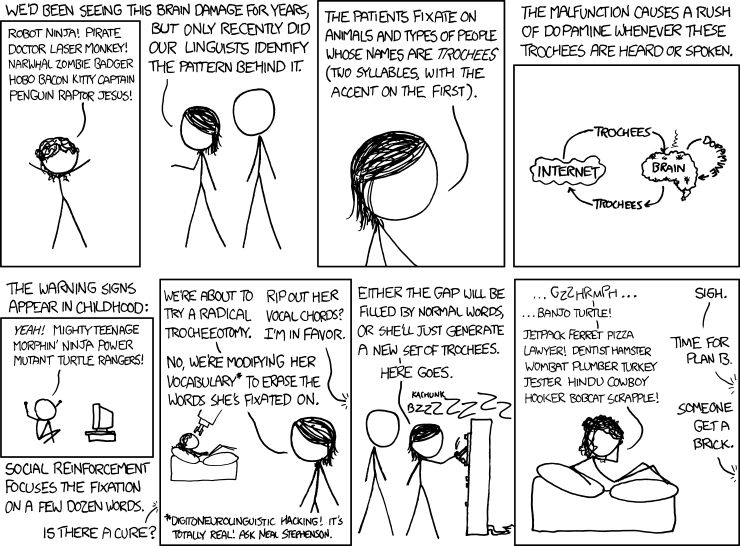
The latest xkcd:

If you Huffman-coded all the 'random' things everyone on the internet has said over the years, you'd wind up with, like, 30 or 40 bytes *tops*.

Click for larger image

Trocheeotomy? Or should it be trochee-ectomy? (~trocheeectomy)

[Some additional things:

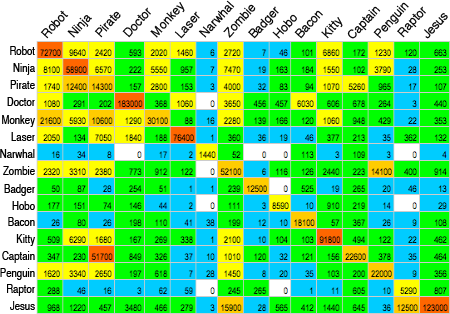
Here's an interesting chart of trochee bigrams from the xkcd blag:

[again, click for larger image]


And Mark Liberman on Language Log offers some discussion here. (I imagine xkcd is thinking of Snow Crash rather than The Big U. By the bye, the linguistic-y part of Snow Crash I've always felt to be the weakest part of the book.) ]

The alt-text:

Monday, 24 January 2011

Good-bye, Good Luck, and Godspeed: On linguistic (de)secularisation

Godspeed
What exactly does someone mean if they wish you Godspeed? Here's one answer, courtesy of comedian Eddie Izzard:

In fact, the speed of Godspeed refers to one of speed's other early senses, namely "success" or "(good) luck, fortune, prosperity". The OED's [1] earliest citation for Godspeed is from Tyndale's Bible translation:
[1526] Bible (Tyndale) - 2 John 10   Yf ther come eny vnto you and bringe not this learninge him receave not to housse: neither bid him God spede.
(Roughly: "If anyone comes to you who does not bring this (Christian) learning, don't let him into your house, nor wish him Godspeed.")
In such early uses of Godspeed, it appears that spede is used as a subjunctive verbal form, so that God spede means something like "may God speed (you)", i.e. "may God grant you success/prosperity".
[1597] Shakespeare Richard II i. iv. 31   A brace of draimen bid, God speed him wel.
More familiar is the use of Godspeed as a noun-noun compound, as in:
[1865] J. R. Lowell Polit. Ess. (1888) 229   Every humane and generous heart‥has wished us God-speed.
However, I have reason to suspect that examples like those from Tyndale and Shakespeare represent a later refashioning: in Old English, the verb spēdan does not seemed to have been used a causative (nor does there appear to be any other causative form of it), while the 16th century examples treat it as such (i.e. X speed Y as "may X cause Y to be speedy/to succeed"). 

Rather Old English spēdan meant simply "to speed, to be successful, to have good fortune", in which case, the later Middle/Modern English God spede should have meant something like "may God be successful" (or "may God go really fast"?!). The equivalent of "God causing someone to be successful"  in Old English required a periphrasis of the sort "God gave speed (i.e. success) to someone", as in:
Exodus 153b-4b: þær him mihtig god on ðam spildsiðe spede forgefe
("if Mighty God would grant them success on the destructive quest")
I argue that the origin of Godspeed is in fact as a compound word, formed of good+speed, which was later reanalysed as God+speed, whence back-formations like God spede (ye), with spede being reanalysed as a causative (i.e. "may (he) cause you to be successful").

Before turning to details of the analysis proper, a quick lesson on some Middle and early Modern English sound changes.

First, the Great English Vowel Shift. I won't go into all of the details here, for they don't concern us, but in general the Great English Vowel Shift raised all long vowels (and diphthongised /ī/ to /aɪ̯/ and /ū/ to /aʊ̯/). More relevantly, Old English gōd "good" (noun and adjective) became /gūd/. By other sound changes, Old English gŏd "god" (originally a neuter noun, but a masculine form was innovated in Christian contexts) became /gɔd/, which by later changes became /gɒd/ (British) or /gɑd/ (American). There were yet later changes affecting ū which caused various (and somewhat sporadic) shortenings, sometimes to /ʌ/ (e.g. blood /blʌd/ from OE blōd) and sometimes to /ʊ/, as in the case of good /gʊd/.

Additionally, in Middle English a phonological change occurred which shortened long vowels in closed syllables which preceded another syllable. For example, consider the changes which occurred in vowel of the first member of the compound words shepherd and wisdom, contrasted with the lack of change in the simplex words sheep and wise, as summarised in the Table below.

Old English Middle English
scēap sheep [shēp]
scēaphirde shĕpherd
wīs wīs
wīsdom wĭsdom

Here the simplex words wise and sheep thus remained unaffected (and became, by the Great English Vowel Shift, /waɪ̯s/ and /ʃīp/, respectively), but the vowels of first component in shepherd ("sheep-herd(er)") and wisdom were shortened.

With these sound changes in mind, let us consider what would have happened to a hypothetical Old English compound *gōd-spēd ("good fortune, good luck"): by the Middle English closed-syllable-before-another-syllable rule, this would become /godspēd/, which would thus have become Modern English Godspeed: /gɒdspīd/ (British), /gɑdspīd/ (American). 

If this etymology is correct, then the original sense of Godspeed is good speed, in other words good luck---which makes eminent sense as a formula of well-wishing (note above in the above video clip, Izzard in fact glosses "good luck" as "Godspeed").

 In fact, an Old English form gōd-spēd is not entirely hypothetical: the adjectival form gōdspēdig is recorded in the verse "translation" of Genesis A:
Genesis A 1008b-9b: Him þa brego engla, godspedig gast geanþingade, "Hwæt...'
("The Lord of Angels (i.e. God), the "good-speedy" spirit, answered him: 'Listen...'")
[This is God addressing Cain, right after Cain utters his signature "I am not my brother's keeper" line.]

The question is how to translate godspedig (though, as is typical of Old English manuscripts, the vowel quantity is not indicated, it is fairly obvious that it is in fact gōdspēdig and not gŏdspēdig, given that it characterises God himself). If it is an adjectivalised noun-noun compound (as Bosworth and Toller treat it in their dictionary [2]), then perhaps "rich in good(ness)". But it could be based on an adjective-noun compound  gōdsped "good fortune", and thus mean something like "one is good at success, full of good fortune". 

In any case the occurrence of gōdspēdig in Old English strengthens the case for Godspeed as originating from gōdspēd "good luck" with god spēde "may God speed/grant good fortune to (you)" being a later reinterpretation (with reanalysis of spēde as causative).

Gospel
Another word which has a similar history is gospel. The original form in Old English was gōdspel "good news", glossing Latin ēvangelium, (from Greek ευαγγελιον (evangelion), from eu- "good" and angelion "message"; but which in classical Greek meant only "a reward for bringing good news," and in the plural "a sacrifice offered on receiving good news"). Now, by the Middle English shortening rule described above, gōdspel would have become gŏdspel, and thus Modern English gospel /gɒspɛl/  (ignoring the loss of the d).

However, in this case, the word was in fact actually reanalysed much earlier, at some point in Old English, as gŏdspel "news about God", apparently based on the written form (which would not have usually indicated vowel quantity), as evidenced by the forms in other Germanic language (the other Germanic peoples were evangelised by Anglo-Saxons): Old Saxon godspell, Old High German gotspell, Old Norse guð-, goðspiall.

Good-bye
Assuming the above proposed etymology for Godspeed is correct: that the original was good speed "good luck" and thus secular in nature, it is interesting to note that exactly the opposite change occurred in the case of Good-bye: an originally religious formula was secularised. Good-bye is a shortening of God be with you(/ye). Here God has been substituted by Good, presumably by analogy with/contamination by other leave-taking formulae like Good Day, Good Night, Good Morning etc.

Summary
Godspeed likely originated as a secular formula "good speed" (i.e. "good luck"), but due to a phonological change in Middle English affecting long vowels in close syllables followed by one or more syllables the vowel of the first word was shorten, becoming homophonous with God, thus giving rise to a reinterpretation of spede as a causative verb meaning "cause to succeed" and resulting in formations like God spede "God prosper (you)". While Good-bye originally had religious connotations, being a shortened form of "God be with you/ye", but by analogy to other leave-taking formula like Good Night, God was substituted by Good. 

One secular formula, go(o)d-speed, was thus reinterpreted as religious in nature, and the other, originally religious formula, go(o)d-bye, took on a secular nature.  

[Updates (04-Feb-2011):

Some new information gleaned from the comments at languagehat's blog:

I. MMcM points out that:
(1) Webster (ca. 1830) glosses godspeed as "good speed" [link to Google Books page here].
(2) Tyndale's Bible translation (whence the first citation of godspeed, see above), also includes good speed [link to Google Books page here]: "LORde God of my maſter Abrahã, ſend me good ſpede this daye, & ſhewe mercy vnto my maſter Abraham".

II. Goodspeed also appears as a surname, e.g. Ben Zimmer's maternal line [hattip Ben Zimmer], the author of the 1923 American Translation of the New Testament, Edgar J. Goodspeed [hattip John Cowan].

]

References:
[1]The Oxford English Dictionary, September 2009 rev. ed.
[2]Bosworth, Joseph and T. Northcote Toller. 1898. An Anglo-Saxon dictionary. London: Oxford University Press.

Wednesday, 12 January 2011

On analogy: Octopuses, Octopi, Octopodes, Emacsen

From a post on boingboing.net, Merriam Webster editor Kory Stamper discusses the "correct" plural of octopus:


Octopus:octopi is a standard example illustrating ("false") analogy that I've used in class before. The story I've told goes like this: Octopus sounds like a Latin word, and so by analogy to Latin borrowings like syllabus:syllabi, alumnus:alumni, people often form its plural as octopi. But, so the standard story goes, it's not a borrowing from Latin, but rather from Greek, so octopi is technically incorrect. The proper Greek plural is rather octopodes.

[More technically, it is a borrowing from Latin, but the Latin word itself is a borrowing/coinage from Greek, and the Greek word would be (in nominative singular) ὀκτώπους (oktṓpous), whose (nominative) plural would be ὀκτώποδες (oktṓpodes). Given that it's a scientific name, it will in fact be a Latin word (albeit one of Greek origins). By modern Latin rules for Greek borrowings, it should be a third declension noun, and form its plural with -es. Thus the Latin forms are octopus:octopodes.]

In the video, however, Stamper makes the following arguments: (1) octopodes sounds rather pedantic (I think a good compromise here though is to pronounce it to rhyme with nodes), and (2) once a word is borrowed into English, it becomes an English word and so should form its plural according to the standard English rules for pluralisation, i.e. it should be octopuses.

In fact, though it is true that -s is the dominant plural ending in English, and thus the one usually used for borrowings and new coinages, it is not the only possibility. Even coinages don't always form plural with -s. For example, there is a powerful text-editing program called Emacs. Different varieties of this program have arisen, and thus a plural form is sometimes called for. And the standard plural used is Emacsen (by analogy to ox:oxen; cf. boxen and VAXen). The point being simply that  if even coinages don't always use the -s plural, then we needn't expect that borrowings should either. And therefore, nothing forces us to accept octopuses as the "correct" plural. [Caveat: of course there is no real "correct" plural for any word, aside from whatever people accept/use.]

But, as it stands, it would seem that the "correct" pluralshould be either octopuses, since that conforms to the dominant pluralisation rule for English, or else octopodes, since octopus is a coinage made from Greek components.

As one of the commenters to the boingboing post (Anon #80) points out though, there is in fact a case to be made for octopi as the "historically correct plural". The case is as follows: Linnaeus may have coined octopus ("eight foot (creature)") by analogy to the old Latin word for "octopus", namely polypus ("many foot (creature)"). Now polypus is obviously also a borrowing from Greek, but in Latin the normal plural of polypus was in fact polypi! (And, likewise, the plural of the modern scientific term polypus is also polypi). 

[The commenter goes on to add that even the Greeks sometimes treated πολύπους (polúpous) as a second declension noun (which would give it a nominative plural of πολύποι (polúpoi). So even the Romans might have had a precedent for their -i plural of polypus.]

So if octopus is seen as a modern "updating" of the original Latin word for "octopus" (polypus), then there is an interesting case to be made for octopi as the (historically) "correct" plural.

Thursday, 6 January 2011

Free OED

Indulge your thirst for etymology. Use the online version of the Oxford English Dictionary free (for a month; until 5 February 2011).

Login with "trynewoed"/"trynewoed."

From languagehat.