Showing posts with label latin. Show all posts

Wednesday, 18 May 2011

The Rapture, now with more Harpies

The latest xkcd:
(Mouse-over text: But to us there is but one God, plus or minus one. --1 Corinthians 8:6±2.)
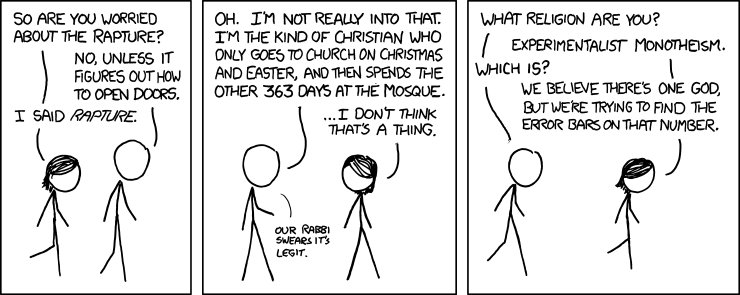
The first panel is really the funniest bit: a pun on raptor (referencing the Jurassic Park movie). But in fact, rapture and raptor are not only phonologically similar, they're also etymologically related: both deriving from Latin rapt-, the past participial stem of rapere "to seize, to snatch, to carry off".

Also from Latin rapere are subreptitious "snatching under", rapacious "(greedily) snatching (with the intent to eat)", and rape (originally "carrying off", then "carrying off, esp. with the intent of sexually despoiling", later coming to refer specifically to "forced sexual intercourse").

Raptor in classical Latin meant "robber, thief", which is its meaning also in early English, later on in English it can also mean "rapist". From the 18th century, it was applied to "birds of prey", whence its later extension to refer to a particular "dromaeosaurid dinosaur", the Velociraptor "swift seizer".

Rapture, on the other hand, is not found in classical Latin, though it does appear in mediaeval Latin. The earliest citation the OED provides is from an 8th-century British text, in the form raptura, referring to "poaching". Its use in English, however, originally is confined to the sense (attested from the 16th century) of "extreme joy, intense delight". Though it was also used in the 17th and 18th centuries to refer to the "carrying off" or "rape" of women.

And not until the 18th century does rapture acquire its Millenarial sense (associated with ideas originally advanced by the Puritans Increase and Cotton Mather in Massachusetts). The word rapture in this Millenarial philosophy apparently picks up on the Latin word rapiemur (from rapere, see above) used in 1 Thessalonians 4:17 to refer to the faithful being "carried up" into the air (to meet Christ) in the Latin Vulgate:
deinde nos qui vivimus qui relinquimur simul rapiemur cum illis in nubibus obviam Domino in aera et sic semper cum Domino erimus
The Latin Vulgate of course is a translation of the Koine Greek text, and in this passage Latin rapiemur glosses the Greek ἁρπαγησόμεθα "we shall be caught up":
ἔπειτα ἡμεῖς οἱ ζῶντες οἱ περιλειπόμενοι ἅμα σὺν αὐτοῖς ἁρπαγησόμεθα ἐν νεφέλαις εἰς ἀπάντησιν τοῦ κυρίου εἰς ἀέρα: καὶ οὕτως πάντοτε σὺν κυρίῳ ἐσόμεθα.
Interestingly, Greek ἁρπάζω "catch up, snatch up"---of which ἁρπαγησόμεθα is the first person plural future passive indicative form---originates from the same Proto-Indo-European root as the Latin rapere which St Jerome uses to gloss it: PIE *h1rep- "to snatch" (also the source of English reap).


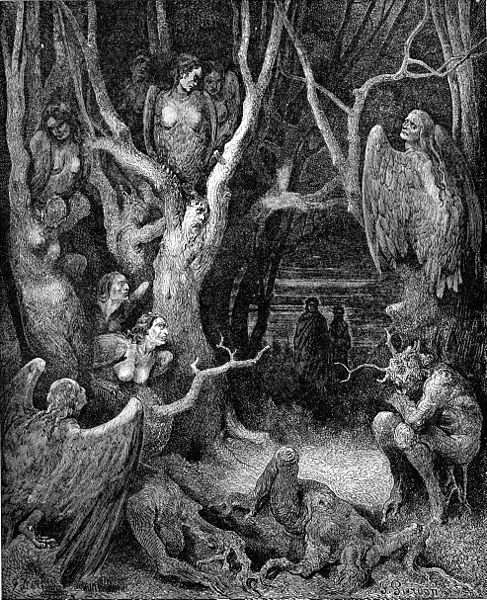
From the same Greek root as ἁρπάζω "catch up" is the word which comes into English as harpy: Greek ἅρπυια "the snatcher". So, with that, I leave you with some Harpies to flavour your Rapturous visions, courtesy of Gustave Doré:
[Edit (20 May 2011): Now see Mark Liberman's "No Word for Rapture" on Language Log for further etymological discussion of rapture.]

Wednesday, 25 November 2009

Condos, Buttocks, and Thorns: On the development of some vulgar Indo-Aryan words and some amusing English-Nepali homophony

The first Nepali word I recall learning in a natural language context (i.e. not from a grammar) is कण्डो (kaṇḍo), for which Turner[1]:70 gives the following definition: "(vulgar) s. Buttock, bottom, rump, anus".

What has provided me with many moments of childish amusement is that this word is essentially homophonous with English condo, the truncated form of condominium: "(N. Amer.) An apartment house in which the units are owned individually, not by a company or co-operative; an apartment in such a building", OED[2]. Thus overhearing people talking about selling their condos for $150,000 etc. always affords me a good (though usually silent) chortle.

Condominium is itself an interesting word, deriving ultimately from a modern Latin formation con+dominium, literally meaning "joint rulership" and appearing with that sense early on:
[a1714] BURNET Own Time (1823) IV. VI. 412 The duke of Holstein began to build some new forts..this, the Danes said, was contrary..to the condominium, which that king and the duke have in that duchy.
The use of condominium (and its truncation condo) to refer to an "individually-owned apartment" appears to be mainly a (recent) North American development; the earliest citation from the OED dates to 1962; the abbreviated condo appears soon after in 1964 (attributed to Chicagoans):
[1962] Economist 31 Mar. 1255/1 The legal concept of buying a single flat, instead of a share in the whole building, is just making its way in the housing field in the United States where it is known as a ‘condominium’.
[1964] Financial Times 27 Nov. 3/6 The condominium or the ‘condo’ as Chicagoans have come to know it is essentially a development from the co-operative concept.
The semantic development from "jointly ruled" to "individually-owned" is rather interesting, indicating that in modern usage the word must be have been reanalysed as monomorphemic (as the sense of "joint, together" of the prefix con-/com- is obviously no longer present).

Returning to the heart (or perhaps 'rump') of the matter, let us consider the etymology of Nepali kaṇḍo "buttock(s)". Turner[1] notes that in Western dialects of Nepali it means "back, spine" and thus compares it to Sindhi kaṇḍo masc. "backbone", Lahndā kaṇḍ fem. "back", Hindi kā̃ṭā masc. "spine", Gujarati kā̃ṭo masc. "backbone", Marathi kā̃ṭā masc. "backbone". He notes if Nepali kaṇḍo is to be considered cognate with these words, it exhibits irregular phonetic development, for the expected form in Nepali would be *kā̃ṛo. He indicates this is not problematic given that "words denoting parts of the body often show irregular phonetic development, whether owing to deliberate deformation or borrowing from other dialects".

Turner[1] suggests that, given this caveat, all of the above words could derive from Sanskrit kaṇṭa-, kaṇṭakáḥ "thorn, fish-bone", with later semantic widening/reanalysis to "bone, back-bone, bottom" etc. These Sanskrit forms are probably also the source, he notes, also of Romani kanro masc. "penis", Bengali kā̃ṭ "clitoris", and (with a much less naughty sense) Oriya kaṇṭi "the wooden part of a plough".

Given the apparent irregularities in the development of Nepali kaṇḍo, Turner[1] also proposes a possible alternative etymology, from unattested Old Indo-Aryan *kāḍa-, citing modern forms: Romani kar m., Sindhi kāṛu masc., Gujarati kāḍ masc., all meaning "penis". This seems less likely to me, as the semantic development from "thorn, fish-bone" > "bone" > "backbone" (as in Western dialects of Nepali) and thence to "buttock(s)" in standard Nepali is much more natural than supposing that a word meaning "penis" developed to mean "backbone, spine" in Western Nepali. Plus, given the hypothetical ancestor *kāḍa, the nasal in Nepali kaṇḍo would be unexpected.

Development from "thorn" to "backbone" and thence to "buttocks" in standard Nepali is easily explicable. The tip of the backbone could be metaphorically conceptualised as a "thorn" (cf. the yogic concept of kuṇḍalinī "the corporeal energy residing in the base of the spine"). From "tip of the backbone" the sense could have been reinterpreted alternatively as "backbone, spine" in Western Nepali, and as "buttock(s)" in standard Nepali.

The other semantic developments in apparently cognate Romani kanro "penis" and Bengali kā̃ṭ "clitoris" represent alternate metaphorical extensions of the original sense "thorn". The naturalness of the metaphorical extension from "thorn" to "penis" is clear in the (nonce?) Hindi usage of कांटा (kāṇṭā) "thorn" in the song Kaanta Laga ("Pricked by a Thorn"):


Where the relevant line is बंगले के पीछे, तेरी बेरी के नीचे, हाय रे पिया, कांटा लगा ("behind the bungalow, beneath your jujube tree, oh darling, (I got) pricked by a thorn").

References:
[1]Turner, Sir Ralph Lilley. 1931. A comparative and etymological dictionary of the Nepali language. London: Routledge & Kegan Paul, Ltd. [Reprinted, Mumbai: Allied Publishers, Ltd., 1980.]
[2]The Oxford English Dictionary, September 2009 rev. ed.

Friday, 16 October 2009

A "Likkle" Sound Change in Jamaican Creole English

This semester I decided to include a "reggae segment" to my undergraduate historical linguistics course, where we look at interesting linguistic changes in both Jamaican Creole and in "Dread Talk" (Rastafarian English), as exemplified by audio clips from various reggae songs. So, in addition to going over the traditional examples of sound change like Grimm's Law and Verner's Law, we also looked at sound change in Jamaican Creole. After discussing Verner's Law as a conditioned sound change, I introduced the phonologically-conditioned "likkle law" of Jamaican Creole English: the sound change /t/ > /k/ which occurs in certain words, such as likkle (< little):
“...Well, me said ‘no, no, don’t be like dat’, me likkle heart a pitter-pat...”
My initial characterisation of the conditions on this change was that /t/ became /k/ intervocalically. My guess was that Jamaican Creole English had been based on a vernacular British dialect in which intervocalic /t/ was realised as a glottal stop (/ʔ/); and that glottal /ʔ/ had been approximated in Jamaican Creole by velar /k/. Thus vernacular British English /liʔḷ/ had been approximated in Jamaican Creole by /likḷ/.

However my students--though the class is smaller than usual, they're a bright batch of students--quickly pointed out that pitter didn't undergo the change, and that therefore the conditioning environment appeared to be more restricted.

I went back and checked Cassidy [1]:40 and found that in fact the conditioning environment does indeed seem to be restricted to instances in which /t/ immediately precedes /ḷ/ or /l/. Examples include /sekḷ/ (settle), /brikḷ/ (brittle), /wakḷ/ (wattle), and /wiklo/ (whitlow) [there is also an apparent example of /t/ > /k/ word-finally, in buck for butt (as in what goats do, not the body-part), but maybe this simply reflects semantic change of buck rather than sound change]. But this now looks like a rather unusual sound change. Why should dental/alveolar /t/ become velar /k/? And why particularly before /ḷ/ or /l/?

Even more perplexing is the fact that Cassidy [1]:40 also states that /d/ becomes /g/ in the same environment: /figḷ/ (fiddle), /rigḷ/ (riddle), /ni:gḷ/ (needle), /kyaŋgḷ/ (candle), /haŋgḷ/ (handle), /dwiŋgḷ/ (dwindle) etc. Now the parallelism of voiced dental stop /d/ becoming voiced velar stop /g/ just as voiceless dental stop /t/ becomes voiceless velar stop /k/ is clear, but the reason for these two changes still seemed rather mysterious.

I think I now might have the beginnings of an explanation. Hallé & Best[2] discuss the fact that French listeners tend to perceive illegal /tl/ and /dl/ clusters as /kl/ and /gl/, respectively, suggesting that /dl/, /tl/ undergo “phonotactic perceptual assimilation” to the phonetically most similar permissible clusters. Could this be what happened in Jamaican Creole?

[Update: My advisor Hans Henrich Hock informs me of some parallel changes in other languages involving /tl/ > /kl/, including:

PIE *pōtlom > Pre-Latin *pōklom > Latin pōculum "cup"

And notes other instances of change which serve to avoid /tl/ clusters, including re-syllabification in Spanish, e.g. atlas "atlas" is syllabified as /at.las/, though coplas "verses" is syllabified as /ko.plas/. See Hock [3]:137.

He also points out Sanskrit examples of avoidance of /dl/ clusters, e.g.:

kṣulla < *kṣudla (= l-variant of Skt. kṣudra "small")
bhalla < *bhadla (= l-variant of Skt. bhadra "auspicious, good") ]

References:
[1]Cassidy, Frederic G. 1971. Jamaica Talk: Three hundred years of the English language in Jamaica. London: Macmillan Caribbean, 2nd edn.
[2]Hallé, Pierre A. & Catherine T. Best. 2007. Dental-to-velar perceptual assimilation: A cross-linguistic study of the perception of dental stop+/l/ clusters. Journal of the Acoustic Society of America 121/5: 2889-2914. [draft version here]
[3]Hock, Hans Henrich. 1991. Principles of historical linguistics. Berlin: Mouton de Gruyter, 2nd edn.

Monday, 12 October 2009

Stæfcræft

The closest Old English term for "linguistics" or "philology" is stæfcræft, literally "letter-skill", a calque of Greek γραμματικὴ τέχνη (grammatikē technē) "art of letters", based on γράμμα (gramma), "letter", which itself derives from γράφειν (graphein) "to write", originally meaning "to scratch" (Old English wrītan "to write" also originally meant "to scratch", cp. German reißen "to tear").

Ælfric of Eynsham (ca. 955-1010), in his translation/adaption of the Latin grammar Exceptiones de Prisciano into English, renders Latin grammatica "grammar" (< γραμματικὴ) as stæfcræft:

GRAMMA on grecisc is LITTERA on leden and on englisc stæf, and GRAMMATICA is stæfcræft.
"Gramma in Greek is littera in Latin and stæf ("letter") in English, and grammatica ("grammar") is stæfcræft."
In the preface to this Old English grammar of Latin, Ælfric says:

Ic ælfric wolde þas lytlan boc awendan to engliscum gereorde of ðam stæfcræfte, þe is gehaten GRAMMATICA, ... forðan ðe stæfcræft is seo cæg, ðe ðæra boca andgit unlicð; and ic þohte, þæt ðeos boc mihte fremian iungum cildum to anginne þæs cræftes, oððæt hi to maran andgyte becumon.
"I, Ælfric, wished to translate this little book on stæfcræft--which is called grammatica--into the English language ... because stæfcræft is the key, which unlocks the understanding of books; and I thought that this book might help young children in the beginning of the art, until they arrive at greater understanding."

Zupitza's edition of Ælfric's grammar and glossary is available on Google books.

High quality scans of St. John's College (Oxford) MS. 154 of Ælfric's text are available here.